UGC Strategy14 min read
UGC Script: How to Write One, With Templates and Examples
How to write a UGC ad script: the structure, how many words fit in 15 or 30 seconds, hook ideas, four templates and a free script timer.
Short answer:
- A UGC script is a short plan for what the creator says and what the viewer sees: a hook, the problem, the product in use, proof and a call to action. Most run 15 to 30 seconds.
- Count words, not lines. At about 150 words a minute, a 15-second ad holds roughly 37 spoken words and a 30-second ad about 75.
- The opening carries the ad. TikTok tells advertisers to land the hook in the first 6 seconds and introduce the product in the first 3, so write 3 to 5 hooks for every body.
- Give creators the must-say lines and talking points, not a word-for-word script. Never write first-person results for someone who hasn't used the product.
Most of a UGC ad's performance is decided before anyone presses record. Most guides that rank for this topic give you a five-part formula and a template. This one covers what they leave out: how many words actually fit in 15 or 30 seconds, how to tell if the script or the delivery is the problem, and what changes when the "creator" is an AI avatar. There's a free script timer further down that times any script line by line.
What is a UGC script?
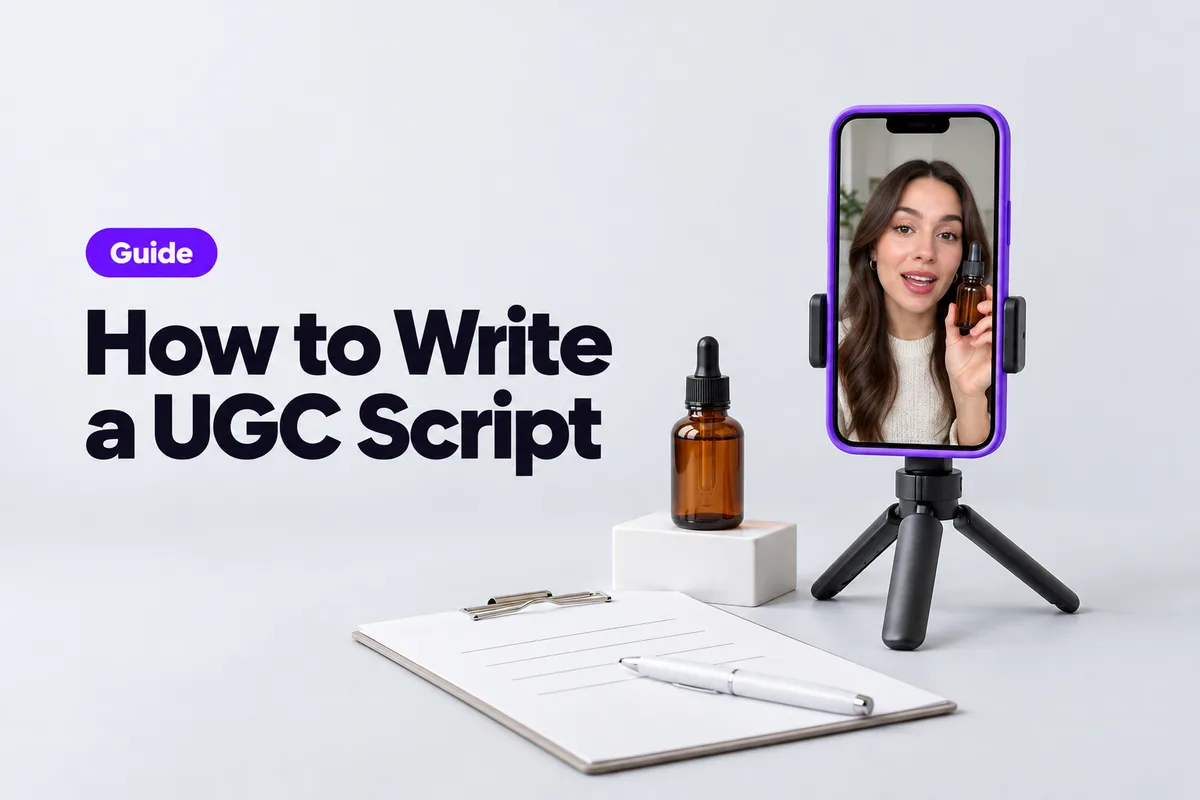
A UGC script is the plan for a video ad shot in the style of user-generated content: what the creator says, what the viewer sees while they say it, and in what order. It's usually less than a page. A 20-second ad can be six lines.
It isn't the same as a brief. The brief gives the context: the product, the audience, the offer, how many videos, and where and for how long you'll run them. The script is the words and shots inside one video. Many brands send both and treat the script as a starting point the creator can rephrase. Our UGC rates guide covers what a brief needs to get an accurate quote.
How long should a UGC script be?
The speaking pace decides it. The National Center for Voice and Speech puts the average rate of speech for American English speakers at "about 150 words per minute" (NCVS). That's 2.5 words a second, which gives you a simple word budget:
| Ad length | Spoken words at 150 a minute | What fits |
|---|---|---|
| 8 seconds | About 20 | One AI clip or a single hook test |
| 15 seconds | About 37 | Hook, one benefit, call to action |
| 30 seconds | About 75 | The full five-beat structure below |
| 60 seconds | About 150 | Demos, comparisons, objection handling |
Leave room for pauses and for shots where nobody talks, like a product being poured or unboxed. A 30-second script with 75 words of talking and no breathing room comes out rushed or runs long. Aim for 60 to 65 words.
People also talk at different speeds, and the same message takes a different number of words in French or Arabic. The timer below can time you reading the script out loud and use your own pace.
The structure most UGC ads follow
TikTok's advice for performance ads fits in one line: "Have a hook, highlight your unique selling points, and end with a clear call-to-action." It also tells advertisers to prioritize the hook "in the first 6 seconds" and to "introduce your content proposition in the first 3 seconds for better recall and awareness" (TikTok creative best practices). Meta's guidance points the same way: its best-performing Stories ads "tend to put their key messages at the beginning of the ad" (Meta creative best practices).
Most UGC scripts fill that frame with five beats. Here's how they fit into 30 seconds, using a face serum as the example:
| Beat | Time | What it does | Example line |
|---|---|---|---|
| Hook | 0 to 3 s | Stops the scroll and signals who it's for | "I almost returned this serum after day one." |
| Problem | 3 to 8 s | A moment the viewer recognizes | "It felt too light, like nothing was happening." |
| Product in use | 8 to 18 s | Shows it working, with one specific detail | "By day ten, the dry patches around my nose were gone." |
| Proof | 18 to 25 s | A reason to believe it | "And it doesn't pill under makeup, which is why I kept it." |
| Call to action | 25 to 30 s | One next step | "Link's below if you want to try it." |
The timings are a guide. What matters is the order: a reason to stop, a reason to care, a reason to believe, then one thing to do. Notice that the product shows up in the first line, which is what TikTok's 3-second advice asks for.
How to write hooks that stop the scroll
The hook is the first line and the first frame together. A great line over a blank wall loses to an average line over a hand holding the product up to the lens. So write the hook first, and write several. TikTok suggests 3 to 5 different creatives per ad group and says "it is always better to use creatives with big differences." New openings on the same body are the cheapest way to get there.
Here are hook types that work for UGC, written for a reusable water bottle:
| Hook type | Example |
|---|---|
| Problem | "My water tasted like plastic for two years and I never noticed." |
| Result | "Still cold at the end of a 12-hour shift. I checked." |
| Objection | "I didn't think a $35 water bottle could be worth it." |
| Mid-action | "Okay, look what happened to my old bottle." |
| Identity | "If you work night shifts, you need to see this." |
Keep hooks short. Three seconds is about seven words at a normal pace. "I almost returned this serum after day one" is eight words, which is already just over three seconds.
A creator in r/UGCcreators described a way out of the blank-page problem that's worth stealing:
"Hook ideation is different from script writing, and trying to do both at once is where all the time goes."
Their method is to pick one angle (a problem, an outcome or an identity), write three variations of it, keep the sharpest, and only then fill in a beat sheet of "hook, credibility/demo, social proof, CTA" one beat at a time (r/UGCcreators). Once the ads run, our hook rate guide shows how to measure which opening stopped more people.
Write it in two columns
A UGC script has two tracks: what the viewer sees and what the creator says. Writing them side by side prevents the most common mistake, a script where the creator talks about the product for ten seconds before anyone sees it.
| What you see | What they say |
|---|---|
| Close-up, bottle in hand near the lens | "I almost returned this serum after day one." |
| At the bathroom mirror, unimpressed | "It felt too light, like nothing was happening." |
| Two drops going on at the sink | "By day ten, the dry patches around my nose were gone." |
| Foundation going on over it, no pilling | "And it doesn't pill under makeup, which is why I kept it." |
| Bottle next to her face, pointing down | "Link's below if you want to try it." |
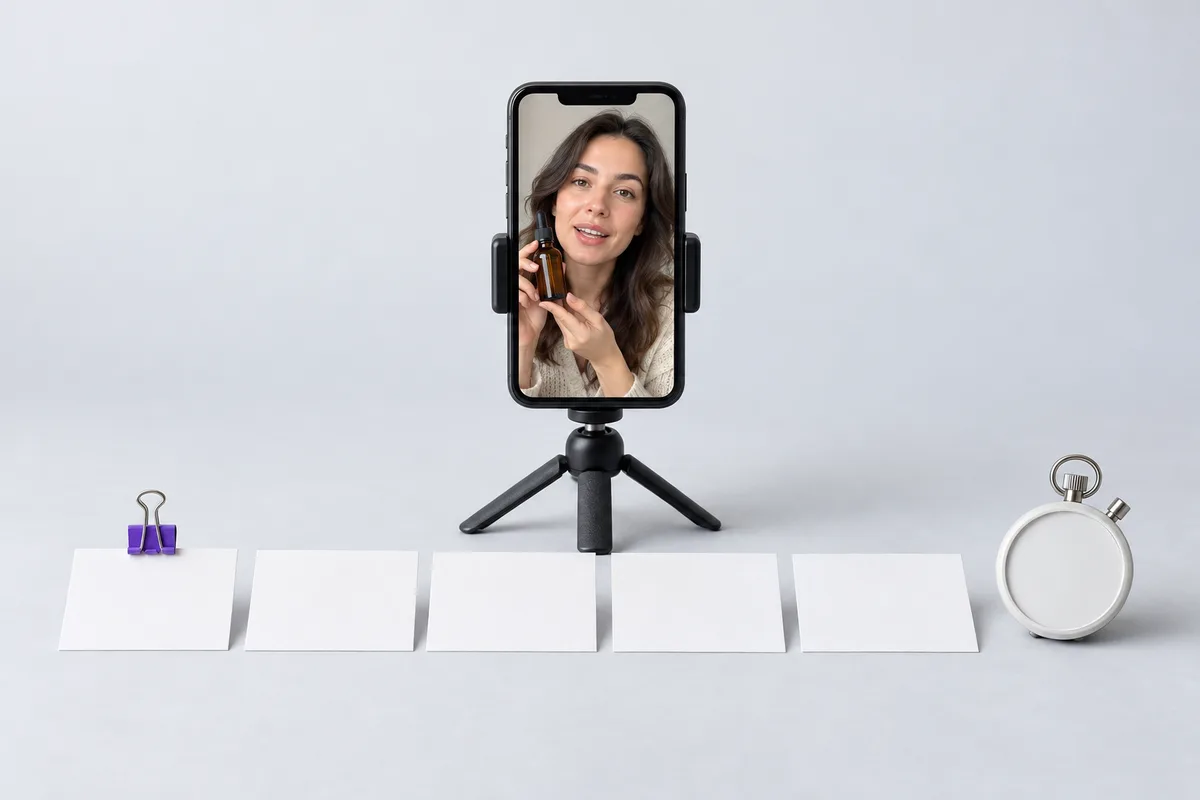
A script is a row of short beats, and the first one has about three seconds to land. Illustration generated with AI.
Put the hook and the main claim on screen as text too, so the ad still works for anyone watching muted. TikTok recommends "captions or text overlays to provide context to your ad." Keep that text away from the buttons and captions each app draws on top; our safe zone checker shows where they sit.
Time your script
Paste your script below, one line per shot. Put what the viewer sees in [square brackets] and the timer leaves it out of the word count. Press "Time my reading" and read the script out loud to set the pace to your own. That matters for French, Arabic and fast talkers, where 150 words a minute is off. The timeline gives each line's start time, and you can copy it straight into a brief. At the default pace, the numbers match the word budget table above.
UGC script timer
Paste a script to see how long it takes to say, whether the hook fits in 3 seconds, and when each line starts.
Spoken length
18.8 s47 words
Fits, with 11.2 s to spare (about 28 more words).
Hook: the first line takes 3.2 s to say. Aim for the first 3 seconds, about 7 words at this pace.
Timeline
- 0:00–0:03[Close-up, bottle in hand]I almost returned this serum after day one.
- 0:03–0:06It felt too light, like nothing was happening.
- 0:06–0:11[At the sink, applying it]By day ten, the dry patches around my nose were gone.
- 0:11–0:16And it doesn't pill under makeup, which is why I kept it.
- 0:16–0:19[Bottle next to her face]Link's below if you want to try it.
Four UGC script templates
Swap the brackets for your product. Each template is a starting point for the creator, not lines to read word for word.
Problem and solution. For products that fix an everyday annoyance. It's the default for a reason: the problem beat does the targeting for you.
[Hook]     "I was so tired of [problem] that I almost gave up on [thing]."
[Problem]  "[The specific moment the problem shows up]."
[Product]  "Then I tried [product]. [What you do with it, in one line]."
[Proof]    "[A specific result, with a number or a time frame]."
[CTA]      "[One next step]."
Objection first. For categories people already know, when the doubt is the price or the claim.
[Hook]     "I didn't think a [price] [product] could be worth it."
[Doubt]    "I'd tried [cheaper option] and it [how it failed]."
[Turn]     "What changed my mind was [one specific feature]."
[Demo]     [Show that feature working]
[CTA]      "If you've been on the fence, [next step]."
Unboxing and first impressions. For launches, gifts and products with good packaging. If the creator got the product free or was paid, the ad has to say so, usually with #ad or the platform's paid partnership label.
[Hook]     "[Brand] sent me this and I wasn't expecting [detail]."
[Unbox]    [Open it on camera, one honest reaction]
[Detail]   "[The thing you'd only notice in person]."
[Use]      [First use, one line]
[CTA]      "[Next step]."
Three reasons. For software, services, and any ad where the presenter hasn't used the product themselves, including AI avatars. It sells on facts, not on a personal story.
[Hook]     "Three reasons [audience] are switching to [product]."
[Reason 1] "[Feature], so you [benefit]."
[Reason 2] "[Feature], so you [benefit]."
[Reason 3] "[Price, guarantee or proof you can show]."
[CTA]      "[Next step]."
For a SaaS product, the "product in use" shots are screen recordings with the creator's face in a corner. Keep each reason to one action someone can see on screen. Most top-ranking script guides only use skincare and gadgets as examples, but this is the template that fits B2B.
Talking points or word for word?
Give creators the lines that must stay fixed and let them phrase the rest. A word-for-word script read by someone who didn't write it sounds read. Mark what can't change: the hook you're testing, the product name, any claim your legal team approved and the offer. Everything else is talking points.
Then read the script out loud before you send it. If you stumble on a sentence, the creator will too. Use contractions, short sentences and words people say out loud ("works" rather than "is effective"). TikTok's advice is to "go for a DIY or not overly polished style," and Meta has seen mobile-shot video "outperform studio shots for ad recall and intent." A script that sounds like a TV ad cancels out both.
Three kinds of lines need extra care. Before-and-after claims: TikTok's ad policy doesn't allow "product effect comparisons, such as before-and-after results, which may cause viewers to have a false or distorted impression" (TikTok ad policy). Comparisons: the same policy wants evidence or a disclaimer, rules out attacks on a named competitor, and lists "Number 1" claims among its examples of what's not allowed. And first-person results like "my dry patches were gone" are only fine when the person saying them really got that result.
Scripts for AI UGC
When the "creator" is an AI avatar, two things change.
First, lines have to fit a clip. AI video tools generate short clips, so you write the script in clip-sized lines. In UGC Builder's Premium UGC, you paste the exact words and an on-screen actor speaks them in an 8-second clip for 200 credits. That's about 20 words per clip at 150 a minute, and the timer above shows whether each line fits. Plans start at $9 a month for 100 credits, and PRO is $19 for 400 (pricing).
Second, and more important, an avatar hasn't used your product. Write it as a presenter, not as a customer. "Three reasons night-shift nurses like this bottle" is fine. "I've used this bottle every shift for a month" is a testimonial from someone who doesn't exist. The FTC's rule on reviews and testimonials bans testimonials that misrepresent whether the person exists or used the product, and the FTC has said that's where AI avatars can cross the line. Our AI ad disclosure guide covers the rule and the labels Meta and TikTok put on AI ads.
When an ad flops, check the script first
Hook rate and hold rate tell you which part of the script to fix. If few people stop (low hook rate), rewrite the first line and first frame and keep the body. If people stop but leave within seconds (high hook rate, low hold rate), the hook promised something the next lines didn't deliver, or the problem beat runs too long, so cut words between seconds 3 and 10. If people watch but don't click, look at the call to action and the offer before you touch anything else. Change one beat per test, so you know which change worked.
FAQ
What is a UGC script?
A UGC script is the plan for a user-generated-content style video ad: what the creator says, what the viewer sees and in what order. Most follow five beats: hook, problem, product in use, proof and call to action.
How long should a UGC script be?
Most UGC ads run 15 to 30 seconds. At about 150 words a minute, that's roughly 37 spoken words for 15 seconds and 75 for 30, minus room for pauses and silent shots.
Should UGC creators get a word-for-word script?
Usually not. Fix the hook, the product name, approved claims and the offer, and give the rest as talking points so it sounds like the creator. Experienced creators often write better lines than the brief.
How many hooks should I write for one UGC ad?
Write three to five hooks for each body. TikTok suggests 3 to 5 different creatives per ad group, and swapping only the opening is the cheapest way to get that variety.
Can I use a UGC script with an AI avatar?
Yes, if you write it as a presenter rather than a customer. Keep each line short enough for one clip and leave out personal results, because an avatar hasn't used the product.
- UGC
- UGC Scripts
- Video Ads
- TikTok Ads
- Meta Ads