Ad Strategy11 min read
Hook Rate: Formula, Good Benchmarks and How to Improve It
What hook rate is, how to calculate it on Meta and TikTok, what counts as a good hook rate, how many impressions you need, and how to raise it.
Short answer:
- Hook rate is the share of impressions where someone watched the first few seconds of your video ad. On Meta it's 3-second video plays divided by impressions. On TikTok, people use 2-second video views.
- Neither platform reports it as a standard column. In Meta Ads Manager you add it as a custom metric in about a minute.
- Analytics tools put a good Meta hook rate around 30% or higher, with 25% as a common floor. These are rough markers, not official benchmarks, so compare ads against your own account first.
- Read it next to hold rate and cost per purchase. A high hook rate on an ad that doesn't sell is a clickbait opening, not a win.
Hook rate tells you whether the first seconds of a video ad stop people from scrolling. It's the quickest creative signal you get, readable long before purchase data settles. Most guides stop at the formula and a benchmark range. This one also covers what they skip: where the published benchmarks come from, how TikTok's numbers differ, and how many impressions an ad needs before its hook rate means anything. You can run your own numbers in our free hook rate calculator.
What is hook rate?
Hook rate (also called thumbstop rate or thumbstop ratio) is the percentage of impressions that turn into a short video view. It measures one thing: did the opening frame and first line get someone to stop?
It isn't an official metric. Media buyers build it from the platforms' own numbers. On Meta, that's 3-second video plays, which Meta defines as "the number of times your video plays for at least 3 seconds, or for nearly its total length if it's shorter than 3 seconds," with replays excluded (About video ad metrics). An impression is counted each time the ad appears on screen, whether or not the video starts.
How to calculate hook rate
The formula is the same on every platform: views at the hook threshold, divided by impressions, times 100. What changes is the threshold.
| Platform | Hook rate | Hold rate (common version) |
|---|---|---|
| Meta (Facebook and Instagram) | 3-second video plays ÷ impressions | ThruPlays ÷ 3-second video plays |
| TikTok | 2-second video views ÷ impressions | 6-second video views ÷ 2-second video views |
Say an ad got 10,000 impressions and 2,800 3-second video plays. Its hook rate is 2,800 ÷ 10,000 = 28%. If 1,200 of those plays reached a ThruPlay (Meta's count of plays to completion or for at least 15 seconds), the hold rate is 1,200 ÷ 2,800 = 43%.
Some people divide hold views by impressions instead. Both versions are fine as long as you stick to one, and our calculator lets you pick.
How to add hook rate in Meta Ads Manager
Meta's help center describes custom metrics step by step (Create custom metrics in Meta Ads Manager):
- In Ads Manager, select Columns, then Customize columns.
- Select Create custom metric.
- Build the formula: pick 3-second video plays, the division sign, then Impressions.
- Name it "Hook rate" and choose the Percentage format.
- Choose who can see it. If you share it with everyone on the ad account, nobody can edit or delete the formula afterwards, so check it first.
- Click Create metric, and repeat with ThruPlays ÷ 3-second video plays for hold rate.
Save the columns as a preset so you see hook rate, hold rate, CTR and cost per result together on every ad.
Hook rate on TikTok
TikTok doesn't have a 3-second metric in its standard video columns. Its help center lists 2-second video views ("at least 2 seconds in an impression session," replays excluded) and 6-second video views, which also count anyone who "received at least 1 engagement within the first 6 seconds" (Video play metrics). So most people calculate TikTok hook rate as 2-second views ÷ impressions.
Because the bar is a second lower, TikTok hook rates run higher than Meta's for the same video. Skaler, a creative analytics tool, tells readers to expect TikTok numbers about 5 to 10 points above Meta (Skaler). Don't compare a TikTok hook rate with a Meta benchmark.
What is a good hook rate?
There's no official answer. Meta and TikTok don't publish benchmarks for it, and the numbers you see in guides come from analytics tools, each with its own customers and method. Here's what they publish for Meta:
| Source | What they call good | Hold rate |
|---|---|---|
| Motion | Below 25% needs work, 25 to 35% is solid, above 35% is strong; target 30 to 40% | 15-second plays ÷ 3-second plays: 40 to 50% on average, over 60% strong |
| Triple Whale | 30 to 45% is a good range | Same formula, no range |
| Superads | 30 to 42% is strong on Facebook | No range |
| Skaler | Median ad 28%, top 10% at 43% or more | No range |
Ranges checked October 11, 2026.
The ranges overlap around 30%, which makes it a reasonable first target on Meta. But vertical matters. Skaler notes that beauty and food products, where the product itself catches the eye, hit higher rates than B2B software, where the product is abstract. A 22% hook rate can be fine for a SaaS ad with a strong landing page.
The better yardstick is your own account. When someone in r/FacebookAds asked what hook rate, hold rate and CPC make an effective ad, one reply gave the usual rule of thumb:
"If the hook rate is above 25 to 30 percent, it means people are actually stopping."
Another answered in four words: "Incrementally better than the previous month." (r/FacebookAds). That second answer is the one to act on. Track your median hook rate and push it up.
Hook rate vs hold rate
Hook rate tells you how many people stopped. Hold rate tells you how many of them stayed. Reading the two together tells you which part of the video to fix:
| Hook | Hold | What it usually means | What to change |
|---|---|---|---|
| High | High | The ad works | Keep it running and test new openings on the same body |
| High | Low | The opening promised something the video didn't deliver | The seconds right after the hook |
| Low | High | The message works but the first frame doesn't stop anyone | The first frame and first line |
| Low | Low | The angle isn't landing | Try a different angle or person, not small edits |
The "high hook, low hold" case is the one to watch. A shocking first line can push hook rate past 40% and still attract people who were never going to buy. That's why hook rate is a diagnostic. The ad still has to earn its keep on cost per purchase or lead.
How many impressions before you judge a hook rate
This is the part most guides skip. A hook rate from a few hundred impressions is mostly noise. At a true hook rate of 25%, here's how wide the 95% margin of error is:
| Impressions | Margin of error |
|---|---|
| 500 | ±3.8 points |
| 1,000 | ±2.7 points |
| 2,000 | ±1.9 points |
| 5,000 | ±1.2 points |
So an ad showing 31% after 500 impressions could really be anywhere from about 27% to 35%. To reliably tell a 25% ad from a 30% ad, you need roughly 1,250 impressions on each (95% confidence, 80% power). Below that, a "winning hook" is often luck.
The calculator does this math for you. It shows the likely range for each ad, flags ads that need more impressions, and only calls an ad better or worse than the rest when the gap is bigger than chance. You can also import an Ads Manager export to check a whole account at once.
How to improve your hook rate
Hook rate is decided in the first frame and the first sentence, so that's where the work goes.
Open with a person, a problem or a result, not a logo. A face looking at the camera, a hand holding the product, or the "after" shot of a before-and-after all give the viewer a reason to stop. A brand intro gives them a reason to scroll.
Make the first second readable with the sound off. Put the hook on screen as text, big enough to read on a phone, and keep it out of the areas the app covers. Our safe zone checker shows where TikTok's and Instagram's buttons and captions sit.
Test hooks on the same body. Keep the middle and end of a video and swap only the first two to three seconds. If hook rate moves and hold rate holds, you've found a better opening without remaking the ad. This is the cheapest test in paid social. Our UGC script guide has hook types to try and a timer that checks the hook fits in three seconds.
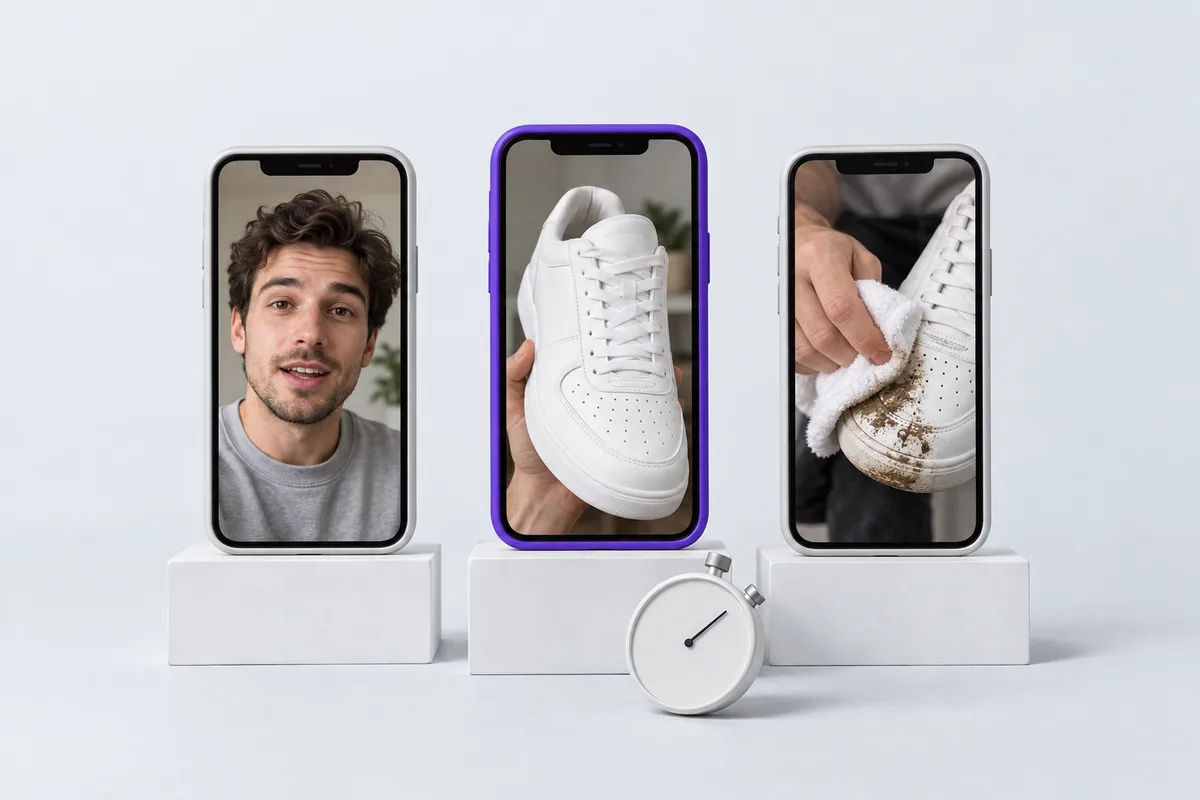
One video, three openings: swapping only the first seconds is the cheapest hook test. Illustration generated with AI.
Try different people and formats, not just new words. Meta's delivery groups similar-looking ads together, so five hooks spoken by the same person in the same room count as less variety than you'd think. Our Meta Andromeda guide explains why real variety matters.
AI-generated UGC makes hook tests cheap. With UGC Builder, one product photo becomes a 5-second selfie-style video for 20 credits, and plans start at $9 a month for 100 credits (pricing). That's enough to try several openings a week, keep the ones with the best hook and hold, and brief real creators on the winners. On TikTok, you can then run the creators' posts as Spark Ads.
FAQ
What is hook rate in Facebook ads?
Hook rate is the share of impressions where someone watched at least 3 seconds of your video ad. You calculate it as 3-second video plays divided by impressions, and add it to Ads Manager as a custom metric because Meta doesn't offer it as a standard column.
What is a good hook rate?
Analytics tools put a good Meta hook rate around 30% or higher, with 25% as a common floor and 35 to 45% as strong. TikTok rates run 5 to 10 points higher because a view counts at 2 seconds. Your own account's median is the more useful comparison.
Is hook rate the same as thumbstop ratio?
Yes. Hook rate, thumbstop rate and thumbstop ratio are names for the same calculation: short video views divided by impressions.
What is the difference between hook rate and hold rate?
Hook rate measures how many people stop scrolling. Hold rate measures how many of them keep watching, usually ThruPlays divided by 3-second video plays on Meta.
Why is my hook rate high but my sales are low?
Usually the opening attracts attention the rest of the ad doesn't convert, or it attracts the wrong people. Check hold rate first, then whether the video and landing page deliver what the hook promised.
- Meta Ads
- TikTok Ads
- Hook Rate
- Video Ads
- UGC