Ad Strategy17 min read
Meta Andromeda: How Many Ad Creatives You Need in 2026
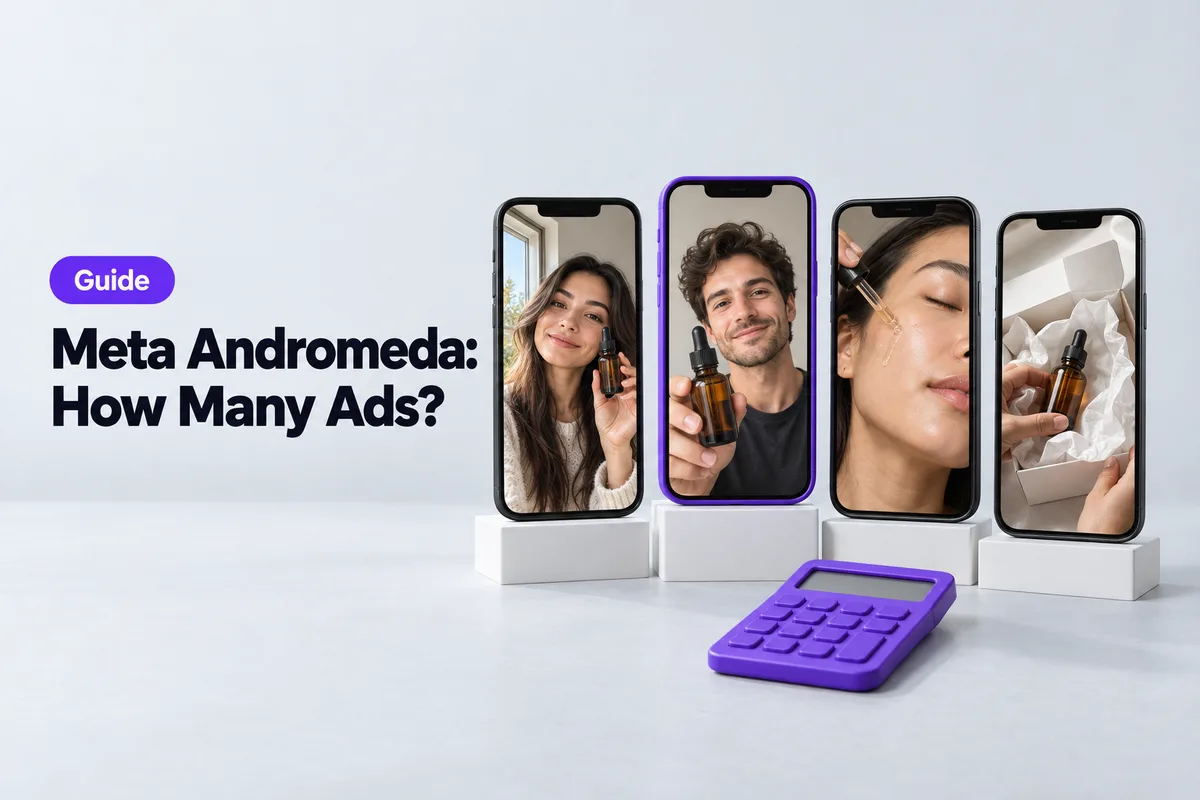
What Meta Andromeda changed, what Meta has actually published, and a calculator for how many new ad concepts your budget can test each week.
Short answer:
- Andromeda is the first step of Meta's ad delivery. It narrows "tens of millions" of ads down to "a few thousand" candidates before ranking and the auction. Meta announced it in December 2024.
- Since then, Meta's main advice is creative diversification: ads with different themes, messages and visuals, so the creative itself finds the right buyers.
- Meta suggests at least 20 diversified ads in an Advantage+ shopping campaign and 20 to 30% of budget for testing. How many new concepts you can actually judge depends on your budget: about 1.5 a week at $100 a day and a $30 target cost per purchase.
- Meta confirms it groups ads that "look or feel alike" and treats them as variations of one creative. "Entity ID" is the agencies' name for this, not Meta's.
Most Andromeda advice comes down to "more creative, more variety." The numbers attached to it don't agree: 8 to 15 ads per ad set, 10 to 15 concepts in total, 50 a month, 500 a month. This guide sticks to what Meta has published and gives you a calculator for the one number that depends on you: how many new concepts your budget can test fairly each week.
What is Meta Andromeda?
Meta picks an ad in three steps. Retrieval builds a shortlist of ads that could fit a person. Ranking models predict how each ad on that shortlist will perform. The auction picks the winner. Andromeda is the retrieval step. In Meta's words, it handles "selecting ads from tens of millions of ad candidates into a few thousand relevant ad candidates" (Engineering at Meta, December 2024).
That makes it a gate. If your ad isn't retrieved for someone, your bid and your landing page never come into play for that person.
Meta built it for scale. The same post says Andromeda runs on NVIDIA Grace Hopper Superchips and Meta's own MTIA chips, allows a 10,000x increase in model capacity, and improved recall by 6% and ads quality by 8% "on selected segments." It also explains why Meta needed it: generative AI was multiplying the number of ads, with "more than a million advertisers" using Meta's tools "to create more than 15 million ads in a month."
Andromeda, GEM and Lattice
Andromeda usually comes up next to two other Meta systems. Here is what each one does, with the numbers Meta has published.
| System | Stage | What it does | What Meta reports |
|---|---|---|---|
| Andromeda | Retrieval | Builds the shortlist of ads for each person | +6% recall, +8% ads quality on selected segments |
| Lattice | Ranking | A model architecture that predicts which shortlisted ads will perform | Almost 12% better ad quality, up to 6% more conversions |
| GEM | Behind both | A foundation model that makes Meta's other ad models better at matching | +5% conversions on Instagram, +3% on Facebook Feed in Q2 2025 |
Sources: Engineering at Meta on Andromeda, Meta for Business, March 2025 and Engineering at Meta on GEM, November 2025.
None of these systems make your ads. GEM has "generative" in its name, but it predicts which ads fit which people. It doesn't create images or videos.
What changed for advertisers
The practical change is where targeting happens. Meta's April 2025 guidance says "the focus has shifted from niche targeting" to "creative diversification as the best lever to find the most relevant audiences" (Meta for Business, April 2025). It defines diversification as "creating a wide range of ad creatives with different themes, messages, and visuals."
Picture a $32 vitamin C serum. In the old setup, you might have built one ad set for women aged 35 to 50 interested in skincare and another for gift shoppers. Now the ad does that work. A woman in her forties talking about dull skin in morning light finds one group of buyers. A boyfriend unboxing the serum as a birthday present finds another. If both ads show the same bottle on the same white background with different headlines, the system has little to tell them apart.
That is also why advertisers have been simplifying accounts: fewer campaigns and ad sets, broad targeting, more distinct ads inside. Meta says advertisers see "a 9% lower cost per action" on average with the streamlined setup for Advantage+ sales campaigns (Meta for Business, April 2025). Its learning phase guide points the same way. It tells you to avoid "high ad volumes" because the delivery system "learns less about each ad and ad set" when you create many of them (About the learning phase). Read together with the diversification advice, the message is fewer near-copies and more ads that are actually different.
Entity ID vs what Meta actually shows you
Many Andromeda guides explain the change with "Entity IDs": similar ads get grouped under one ID, so 50 near-identical ads get one ticket to the auction. The name is agency shorthand. One of the guides that ranks for "meta andromeda" calls it "an explanatory device for this clustering behavior rather than an official term Meta publishes" (Ads Uploader).
The behavior is real, though. In December 2025 Meta wrote that its "ads system also analyzes creatives and groups together ads that share key visual and thematic attributes," and that "when multiple ads look or feel alike, these are seen as variations of the same creative." Learning and delivery are "shared at the creative level – not just the individual ad level" (Meta for Business, December 2025). Meta doesn't say near-copies are penalized. But ten near-copies give the system one creative to learn from, not ten.
Meta also documents a check you can run yourself. Account insights in Meta Ads Reporting includes a creative similarity insight. Meta's definition: "Creative similarity occurs when the images or videos in your ads appear too visually identical. This can lead to creative fatigue and increase your cost per result." The advice is short: "we recommend creating new ads with unique creative." The insight covers static ads that were active in the last 28 days, and Meta notes it may not be available to every account yet (About Account insights).
Ads Manager also flags fatigue in ad sets that run a single creative. When cost per result is higher than your past ads but less than double, the Delivery column shows Creative limited. At double or more, it shows Creative fatigue. Meta counts "all recent exposures of the ad's image or video, including those from other campaigns from your Page," and the fix it suggests is a new ad "that is materially different from the original creative" (creative fatigue recommendations).
Two things follow. A new headline on the same image or video is not a new creative: Meta's own example of mere iteration is "two ads with identical visuals, but different text CTAs." And moving a tired video into a new campaign doesn't reset anything, because exposures from your other campaigns count too.
What counts as a different creative
Meta's wording gives you two working rules. If the picture or footage stays the same, it's the same creative. And because Meta also groups by "thematic attributes," new footage that tells the same story may still count as one. Its advice is to make ads "truly different in look, feel, storyline, and message." Here is how common changes stack up.
| Change | New creative to Meta? | Why |
|---|---|---|
| A different person speaking to a different buyer | Yes | New footage and a new reason to watch |
| A different format: selfie video, static, carousel, demo | Yes | The visuals differ from the first frame |
| A different story told with new footage: problem first, comparison, unboxing | Yes | New visuals and a new reason to buy |
| A new setting with the same script | Sometimes | The image changes but the story doesn't. It helps most when the setting points to another buyer, like a gym instead of an office |
| A new hook line, headline or primary text over the same video | No | Same visuals. Meta calls this iteration, not diversification |
| A new button color, filter or logo position | No | This is what "too visually identical" means |
| The same video cut to 1:1, 4:5 and 9:16 | No | These are placement versions of one ad |
Meta hasn't published an exact threshold, and the similarity insight only covers static ads. Treat the table as the safe reading of Meta's definitions, not as a spec.
Here is what six concepts for the $32 serum could look like. Each one changes the person, the format and the reason to buy at the same time.
| Concept | On screen | Format | Message |
|---|---|---|---|
| Morning check | A woman in her forties by a bathroom window | Selfie video | "My skin looked tired in every photo" |
| The skeptic | A man who has never used skincare | Selfie video | "My girlfriend made me try it for two weeks" |
| Routine | A hand applying drops in front of a mirror | Demo video | Three drops, then moisturizer, in 20 seconds |
| Ingredients | The bottle on a stone tray | Static image | What vitamin C does, in plain words |
| Price check | Two bottles side by side | Carousel | What $32 gets you next to a $90 serum |
| Gift | An unboxing on a bed, with a ribbon | UGC photo | The birthday present she actually uses |

Six concepts for one product: different people, formats and reasons to buy. Illustration generated with AI.
Dara Denney breaks creative diversity into five levels, from visual changes up to reaching new personas. It's worth ten minutes before you plan your next batch.
For more angles to borrow, see our UGC campaign ideas.
How many creatives do you need?
This is where the advice online falls apart. Depending on who you read, you need 8 to 15 ads per ad set, 10 to 15 concepts in total, 50 a month, or eventually 500 a month. None of these numbers ask about your budget, which is why they disagree. A brand spending $1,000 a day and one spending $100 a day can't test the same number of ideas.
Meta's own numbers are a better starting point. It recommends "maintaining at least 20 diversified ads in Advantage+ shopping campaigns" and "dedicating 20-30% of your overall ad budget towards testing new ads," and it suggests that you "routinely launch new ads on a weekly basis" (Meta for Business, November 2024). Every ad set is capped at 50 ads (ad limits).
Those 20 ads describe the pool you keep running. The number that depends on you is how many new concepts you can test fairly each week, and that takes spend. A useful rule is to give each new concept three times your target cost per purchase before you judge it. If an ad performs exactly at target, three times the target cost should bring about three sales. When you expect three sales, the chance of seeing none by bad luck is about 5%, so an ad with zero sales at 3x is very likely worse than your target. At 2x, bad luck explains a zero about 14% of the time.
The math takes three steps:
- Weekly budget for new ads = daily budget × 7 × the share you set aside. Meta suggests 20 to 30%.
- Spend per concept = target cost per purchase × 3.
- New concepts per week = weekly budget for new ads ÷ spend per concept.
Creative testing calculator
How many new ad concepts can your budget judge fairly?
1.5new concepts per week
6new concepts per month
- Weekly budget for new ads:
- $140
- Test spend per concept:
- $90
Plan a small weekly batch. Make each concept a different angle, person or format, not a recolor of your best ad.
Here is the same math for common budgets, with 20% of spend for new ads and 3x the target cost per concept:
| Daily budget | $30 target: per week | $30 target: per month | $60 target: per week | $60 target: per month |
|---|---|---|---|---|
| $50 | 1 every 2 weeks | 3 | 1 every 3 weeks | 1 |
| $100 | 1.5 | 6 | 1 every 2 weeks | 3 |
| $300 | 4.6 | 20 | 2.3 | 10 |
| $1,000 | 15 | 66 | 7.7 | 33 |
The table explains why the online numbers disagree. "50 new ads a month" is realistic for a brand spending about $1,000 a day. For a store spending $100 a day, it means launching ads that never get enough spend to tell you anything, which is exactly the "high ad volumes" problem Meta's learning phase guide warns about. Meta's own example of a brand that went from "3-4 new creatives a week to almost 50" sounds like a target until you run the numbers: judging 50 new concepts a week at a $30 target takes about $3,200 a day.
If your number is under one a week, launch one concept at a time, make it very different from your current ads, and give it longer. If it's between one and five, plan a small weekly batch. Above that, your limit is production, not spend. Whatever your number, keep the ads that work running. Even when an ad set shows fatigue, Meta notes that keeping the original ad active instead of pausing it "may maximize results."
How to test new concepts in a simple account
A routine that follows Meta's guidance and fits the calculator:
- Keep one main sales campaign with broad targeting. Put new concepts into it, or into one testing ad set that gets your 20 to 30%. What matters is that each concept gets its 3x before you judge it.
- Launch new concepts once a week as a batch, sized by the calculator.
- Don't edit them during the first week. Edits can restart the learning phase, which usually ends "after about 50 results in the week after the ad set's last significant edit."
- Judge concepts, not single ads. When a concept wins, make new versions with new people or settings, not new button colors.
- Once a month, check Account insights for creative similarity and top creative themes, and replace anything marked Creative fatigue with something materially different.
A common complaint is that Meta gives new ads almost no spend. If a concept gets less than its 3x in a week, it hasn't been judged yet, so leave it a second week. If it still gets nothing, check it against the table in "What counts as a different creative": ads that look like something already running tend to lose to the original. When you need a clean read, move new concepts into the separate testing ad set.
Where the creative volume comes from
Production is the real constraint, and advertisers know it. In an r/FacebookAds thread asking whether Andromeda is "real innovation or just hype," one advertiser spending $100 to $500 a day said they were "up across all accounts" with "1 adset, bunch of ads with different persona driven creatives." Another reply named the cost of working this way:
"...not just iterations on what is working for you but entirely new variations. The issue is, a lot of businesses simply aren’t set up for that."
A reply on r/FacebookAds
Most brands mix four sources. Customer videos and reviews are the most convincing, but you can't order them on a schedule. Paid creators are great for hands-on demos, but each new person on camera is a new booking, a new fee and a usage-rights conversation. We compared what UGC agencies and creator platforms charge if you go that way. Your own team can cover founder stories and behind-the-scenes clips. AI-generated UGC fills the rest.
AI UGC is the quickest way to change the things Meta groups ads by: the person, the setting and the story on screen. With UGC Builder's UGC Video tool, one product photo becomes a 5-second selfie-style video for 20 credits, and a UGC photo costs 4 credits. Plans are monthly subscriptions from $9 for 100 credits, and credits expire after 30 days (pricing). The $100-a-day store from the table tests about six concepts a month. If each concept is one video plus two photos (28 credits), that's 168 credits, which the $19 PRO plan with 400 credits covers.
Know the limits before you rely on it. AI creators are good at talking to the camera and holding a product. They're weaker at close hand work, like squeezing a tube or applying makeup. If the proof of your product is in the hands, film a real person for that concept and use AI for the angles around it. To compare options, see our list of the best AI tools for UGC videos.
FAQ
What is Meta Andromeda?
Andromeda is the retrieval system in Meta's ad delivery. It narrows tens of millions of possible ads to a few thousand candidates, which ranking models and the auction then choose from. If an ad isn't retrieved for a person, it can't be shown to them.
When was Meta's Andromeda update?
Meta announced Andromeda on December 2, 2024, and said it was already deployed across Facebook and Instagram. Its creative diversification guidance for Andromeda followed in April 2025.
How does Andromeda decide which ads to show?
It uses machine learning models to match ads to people. Meta hasn't published the full list of signals, but its guidance calls creative diversification "the best lever to find the most relevant audiences," so the content of your ad now does much of the targeting.
Is Entity ID a real Meta feature?
Not by that name. It's the term agencies use for a behavior Meta has confirmed: in December 2025, Meta said its system "groups together ads that share key visual and thematic attributes" and treats ads that look or feel alike as variations of the same creative. The check Meta documents is the creative similarity insight in Ads Reporting.
How many ads should I put in one ad set?
Meta allows up to 50 ads per ad set and recommends at least 20 diversified ads in Advantage+ shopping campaigns. How many new concepts you add each week should follow your budget: at $100 a day and a $30 target cost per purchase, it's one or two.
- Meta Ads
- Meta Andromeda
- Creative Strategy
- AI UGC
- Video Ads
- AI Marketing