Ad Strategy16 min read
AI Ad Disclosure: Meta, TikTok, FTC and EU Rules for 2026
When AI-generated ads need a label on TikTok, Meta and Google, what the FTC and the EU AI Act require, and how to write AI UGC that stays honest.
Short answer:
- TikTok requires a label on ads that are fully AI-generated or significantly changed by AI. Turn on "This ad contains AI-generated content" in Ads Manager, or label the post itself for Spark Ads. Undisclosed AI ads get rejected or restricted.
- Meta doesn't ask you to label regular product ads. It adds an "AI info" label itself when it detects generative AI. Self-disclosure is mandatory only for social issue, election and political ads.
- The bigger legal risk is the script. The FTC bans testimonials that misrepresent whether the person exists or used the product, so an AI avatar shouldn't say "I've used this for a month."
- In the EU, realistic AI people and scenes can count as deepfakes under the AI Act, which has required a visible disclosure since 2 August 2026.
AI avatars, AI voiceovers and generated product shots are now ordinary parts of ad production. The rules for labeling them are spread across three ad platforms and several laws, and most guides blur them together. This one keeps them apart and quotes each platform's or regulator's own pages, all checked on October 14, 2026. It's a guide for marketers, not legal advice.
The rules at a glance
| When it applies | What you do | If you don't | |
|---|---|---|---|
| TikTok | Image, video or audio fully made or significantly changed by AI | Turn on the AI-generated content disclaimer in Ads Manager; for Spark Ads, turn on the AI-generated content setting on the post | Ad rejected or restricted |
| Meta, regular ads | Meta detects generative AI, or you used its AI tools | Nothing required; optional self-disclosure in the EU, California, New York, India and Taiwan | Not applicable, the label is automatic |
| Meta, social issue, election or political ads | Photorealistic media or realistic audio made with AI to show something that didn't happen | Select "Includes media created or edited with AI" | Ad removed; repeat failures bring account penalties |
| Google Ads | Assets created or edited with AI, where local law requires a label | Use the AI label setting | Google says the setting alone doesn't guarantee compliance |
| FTC (United States) | A testimonial that misrepresents whether the person exists, used the product, or what happened | Don't present AI people as real customers | Civil penalties for knowing violations |
| EU AI Act | Deepfakes: realistic AI content that would falsely appear authentic | Disclose it clearly, at first exposure at the latest | Fines up to €15 million or 3% of worldwide turnover |
Rules checked October 14, 2026. Sources are linked in each section below.
TikTok: label every ad that's made or heavily edited with AI
TikTok has the strictest platform rule. Its ad disclaimer page lists "AI-generated, synthetic, or manipulated media" as a mandatory disclaimer, covering "images, video, or audio that are completely AI-generated or real source material that has been significantly modified by AI" (ad disclaimers).
The ad policy spells out what "significantly" means. Fully AI-generated images, video or audio count. So does real footage changed so the main subject does something they didn't do, or says something they didn't say "using AI voice-cloning." Minor AI edits don't count: lighting and color adjustments, removing or changing backgrounds, and denoising. When in doubt, TikTok's advice is "to use caution and label it accordingly," and the consequence of skipping the label is blunt: "If we identify AI-generated content that has not been disclosed, your ad will be rejected or restricted" (TikTok ad policy). The same policy lets you disclose with the AIGC label or with "a clear disclaimer, caption, watermark, or sticker of your own."
For a regular in-feed ad, check "This ad contains AI-generated content" during ad creation in Ads Manager. The disclaimer then shows at the bottom of the video for as long as the ad runs. Two details catch people out. Once you submit, you can't turn the toggle off unless you change the video or image. And any new campaign, including a duplicated one, resets the toggle, even if you reuse an ad that had it on (how to add disclaimers). Check it every time you duplicate. If the option doesn't show up, TikTok says to contact your sales representative.
Spark Ads work differently. The Ads Manager toggle doesn't apply to them, because Spark Ads "live organically on TikTok" and follow the Community Guidelines. Turn on the AI-generated content setting in the app when you post (under More options), and the post shows "creator labeled as AI-generated." TikTok can also add its own "AI-generated" label when a file carries C2PA Content Credentials, and that automatic label can't be removed (About AI-generated content). Our Spark Ads guide covers the rest of the setup.
Some AI content is off-limits even with a label. TikTok doesn't allow the likeness of adult private individuals used without their permission, the likeness of anyone under 18, or public figures falsely shown giving or receiving an endorsement. An AI copy of any real person promoting your product needs that person's permission.
Meta: the label is automatic for most ads
Meta takes the opposite approach for regular commercial ads. It doesn't ask you to declare AI use. It labels the ad itself in two cases: when you use its generative AI features, "such as Background Generation, Image Generation, or Add Animation," and when it detects that third-party AI tools made or edited the ad, using "industry-standard detection methods, such as C2PA" (About AI info on ads). Ads Manager tells you before you publish when an AI info label will appear.
For most viewers that label isn't on the ad. It sits in the three-dot menu, under About this ad. The exception is a list of places where "local laws or guidelines include specific AI transparency requirements": the European Region, California, New York, India and Taiwan. There, you can self-disclose that generative AI was used, and the label then appears on the ad itself, next to the Sponsored label. In Taiwan and South Korea, Meta may also label ads automatically when its own tools generated photorealistic people. If you boost an organic post that already carries an AI label, the label may stay on the ad.
Ads about social issues, elections or politics are the one place Meta makes disclosure mandatory. Advertisers must disclose when such an ad uses a photorealistic image, video or realistic audio made or edited with AI to show a real person saying or doing something they didn't, a realistic person who doesn't exist, or an event that didn't happen. You do it by selecting "Includes media created or edited with AI" in Ads Manager. Resizing, cropping, color correction and sharpening don't count. Skip it and "your ad may be removed," and repeated failures can bring penalties on the account (AI disclosure for political ads). These ads can't run in the EU at all.
A media buyer in r/facebookadsexperts asked whether moving part of their UGC budget to generated video would put the ad account at risk. The most useful reply matched what Meta's help pages say:
"AI generation itself isn't on the prohibited list - Meta's ad standards govern what the ad claims and where it leads, not which tool made it."
The same reply listed what does get ads rejected: unsubstantiated claims, personal attributes, before-and-after images, restricted categories and landing pages that don't match the ad (r/facebookadsexperts).
Google Ads: a new AI label setting
Google added an AI label setting in July 2026. You mark assets as "created or edited with AI," and the ad then includes a disclosure in the "How this ad was made" section of My Ad Center, the three-dot menu on ads across Search, YouTube and Discover. For campaigns that target the European Union, India or New York, those assets also get a visible label on the ad. Google may label assets itself, for example when its fully automated features made them, and those labels can't be overwritten. Google also warns that using the setting "doesn't guarantee your compliance with specific regulations" (Google Ads Help).
The FTC: it's about who's talking, not which tool made the video
The FTC hasn't issued a rule that says "label your AI ads." What it has is a rule on consumer reviews and testimonials, in effect since October 21, 2024. It makes it illegal for a business to create a consumer testimonial that misrepresents "that the reviewer or testimonialist exists," that they "used or otherwise had experience with the product," or what that experience was (16 CFR 465.2). Courts can impose civil penalties for knowing violations.
The FTC has answered the AI question directly. Asked how the rule applies to AI stock avatars like TikTok's Symphony Avatars, it said "the rule has no blanket prohibition on the use of AI-generated avatars in marketing." But an avatar's message "might be considered a 'testimonial' under the rule," and it would be prohibited "if the underlying testimonials were fake or false." Using a celebrity avatar without permission to praise a product would also violate the rule (FTC Q&A). The Endorsement Guides the FTC points to add a rule that fits AI UGC closely: ads that present endorsements as coming from "actual consumers" should use actual consumers, or clearly disclose that the people shown aren't (16 CFR 255.2).
So the line runs through the script, not the label. An AI person saying "Here are three things this serum does" is a presenter. An AI person saying "I've used this every morning for three weeks and my skin cleared up" is a customer testimonial from someone who doesn't exist and never used the product, and a label doesn't fix that. Our UGC script guide has a "three reasons" template written for exactly this case.
Real creators have their own disclosure duty. When you pay a creator or send free product, the ad has to show that relationship, usually with #ad or the platform's paid partnership label. Our UGC basics guide covers that, along with usage rights.
States are adding their own rules on top. In December 2025, New York signed a law that requires anyone who produces or creates an ad to disclose when it includes AI-generated synthetic performers, which it describes as "digitally-created media that appear as a real person" (New York State). Meta and Google both list New York among their AI labeling regions.
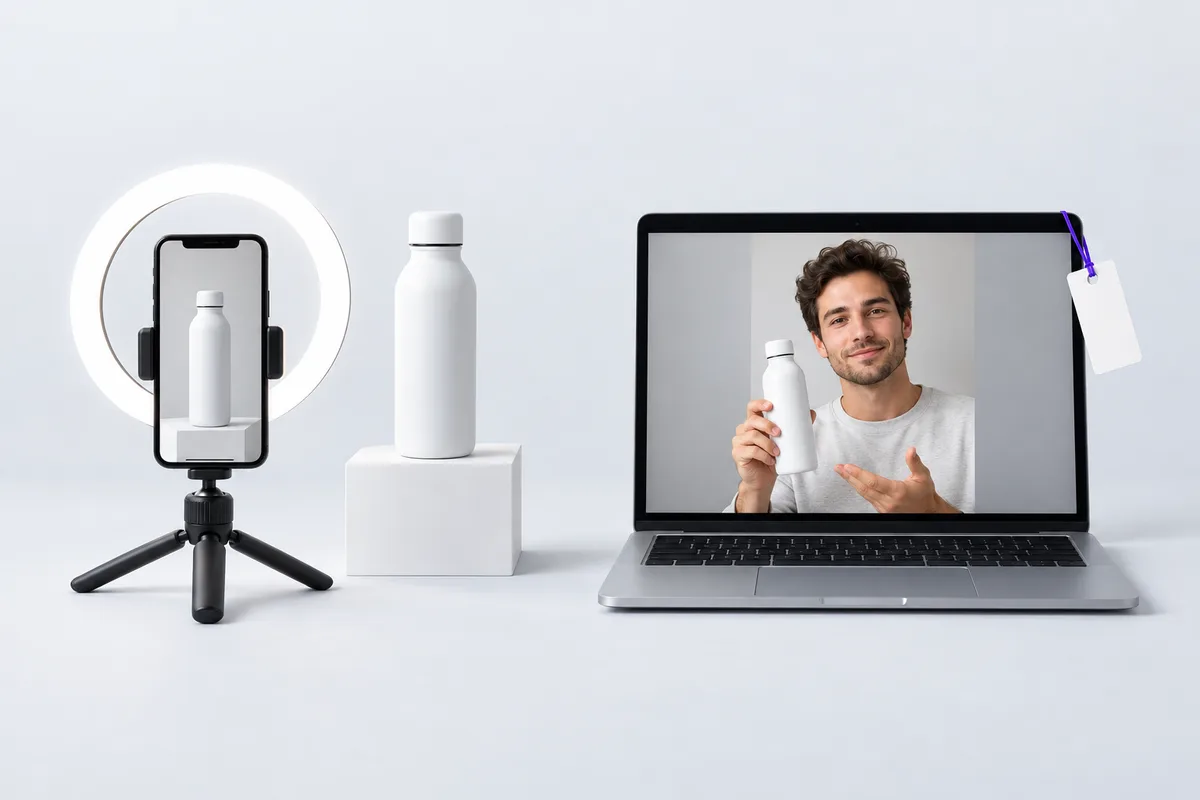
Filmed or generated: the labels depend on how the ad was made, the legal risk on what it claims. Illustration generated with AI.
The EU AI Act: deepfakes need a visible label
Article 50(4) of the AI Act says that anyone using an AI system to generate image, audio or video content "constituting a deep fake, shall disclose that the content has been artificially generated or manipulated." A deepfake is AI content that "resembles existing persons, objects, places, entities or events and would falsely appear to a person to be authentic or truthful" (Article 50). The obligation applies from 2 August 2026. Breaking it can cost up to €15 million or 3% of worldwide annual turnover, whichever is higher (Article 99).
The European Commission's FAQ answers the questions advertisers care about (Commission FAQ):
- A person or object doesn't have to be real to count. It only has to resemble something that "exists, can plausibly exist or could have plausibly existed in reality." A realistic AI person in a selfie video meets that test.
- The company is the one that has to disclose, even when freelancers or contractors make the content. The FAQ uses "an advertising company" as its example.
- Metadata isn't enough. People must be able to see or hear the disclosure "without need for any specific technical tools," so you "cannot simply rely on the machine-readable marking" a tool embeds.
- Content made before 2 August 2026 doesn't need to be labeled retroactively.
Whether a given ad "would falsely appear to be authentic" depends on context and audience, and the Commission's guidelines leave room for judgment. A selfie-style video of a "customer" is built to look authentic, though, so treat realistic AI UGC as needing a label when it runs in the EU. Meta's self-disclosure option and Google's on-ad label in the EU, or a short "AI-generated" note on the video itself, do that job.
Do you need to label it? Common cases
| What's in the ad | TikTok | Meta (regular ads) | Script and legal risk |
|---|---|---|---|
| A fully AI video of a person talking about the product | Label required | Labeled automatically if detected; self-disclose in the regions above | Fine as a presenter, not as a customer sharing results; label in the EU and New York |
| A real creator dubbed into another language with an AI copy of their voice | Label required (they're saying words they didn't say) | Labeled automatically if detected | Fine if the creator really used the product and agreed to the dub |
| Real footage with AI background removal or color fixes | No label needed | May be labeled if the file carries AI metadata | No issue |
| A fully AI-generated product photo or scene | Label required | Labeled automatically if detected | Show the product as it really is |
| A script written with an AI chatbot, filmed by a real creator | Not covered: the rule is about images, video and audio | No label | Only claim results the creator actually had |
| An AI copy of a real person without their permission | Not allowed | A label doesn't make it acceptable | A celebrity "testimonial" without permission breaks the FTC rule |
How to make AI UGC that stays honest and still sells
Write AI avatars as presenters. They can show the product, explain features, compare prices and read out real reviews with the reviewer's name and permission. They shouldn't tell a personal story about using it. That rules out a few hooks, but "Three reasons night-shift nurses switch to this bottle" still stops the scroll.
Label at the source. On TikTok, turn the toggle on (or the setting on the post for Spark Ads) every time you launch or duplicate. Don't strip a file's metadata to avoid labels. On TikTok an undisclosed AI ad gets rejected or restricted anyway, and the EU and New York rules don't depend on metadata.
Use AI for what it's good at. AI-generated UGC is cheapest for testing hooks and angles before you pay creators. With UGC Builder, one product photo becomes a 5-second selfie-style video for 20 credits, on plans from $9 a month for 100 credits (pricing). Those videos are AI-generated, so everything above applies to them: label them on TikTok, write them as a presenter, and brief real creators on the angles that win.
Does the AI label hurt performance?
Nobody has published reliable ad-level numbers. TikTok says that turning on the AI-generated content setting "won't affect the distribution of your video as long as it doesn't violate our Community Guidelines," but that statement is about posts, not paid delivery. Meta keeps the label in a menu outside the regions listed above, so most people never see it. If you're worried, compare a labeled AI version with a real creator version on cost per result. That's the comparison that tells you something, since leaving the label off isn't an option on TikTok anyway.
FAQ
Do I have to disclose AI-generated ads on Meta?
Not for regular product ads. Meta labels ads automatically when it detects generative AI or when you used its AI tools, and you can self-disclose in the EU, California, New York, India and Taiwan. Ads about social issues, elections or politics must disclose photorealistic AI media.
Do I have to label AI ads on TikTok?
Yes, if the ad's image, video or audio is fully AI-generated or significantly modified by AI. Use the AI-generated content toggle in Ads Manager, or the AI-generated content setting on the post for Spark Ads. TikTok rejects or restricts undisclosed AI ads.
Is it legal to use AI avatars in ads?
Generally, yes. The FTC says its rule has no blanket ban on AI avatars, but it does ban fake testimonials, so an avatar shouldn't claim personal experience with the product. In the EU, realistic avatars need a visible AI disclosure from 2 August 2026.
Does the AI-generated label reduce reach?
TikTok says its AI label doesn't affect a post's distribution, and Meta shows the label in a menu for most viewers. No platform has published data on ad performance, so test labeled AI ads against creator ads on cost per result.
Do I need to relabel old ads for the EU AI Act?
No. The European Commission says content generated before 2 August 2026 doesn't need to be labeled retroactively, though it encourages it. New content shown to people in the EU needs the disclosure.
- AI UGC
- Meta Ads
- TikTok Ads
- AI Marketing
- Video Ads