UGC Strategy15 min read
AI UGC vs Real UGC (2026): Cost, Trust and When Each Wins
AI UGC vs real creator UGC: cost per video, turnaround, trust, what the studies show, the FTC line on fake testimonials, and a workflow that uses both.
Short answer:
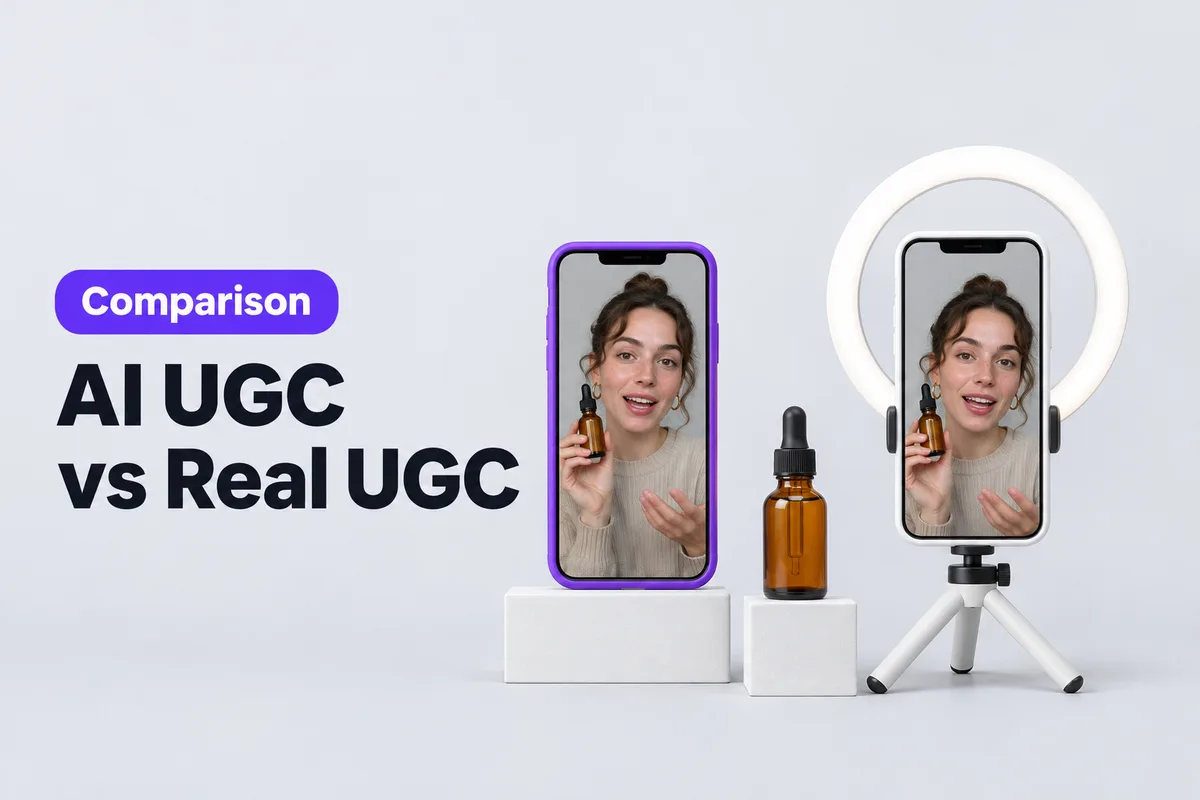
- AI UGC is a selfie-style video ad made partly or fully with AI: an AI avatar or a generated person presents your product. Real UGC is filmed by a person who actually has the product in hand.
- AI wins on cost and speed. A short AI clip costs a few dollars or less, while a beginner creator charges $50 to $400 a video and experienced ones much more. That makes AI the cheap way to test hooks and angles.
- Real creators win on proof. In the most rigorous public test, by Ipsos in 2026, human-made brand ads beat AI-made ones by 14% on short-term and 17% on long-term effectiveness. Testimonials, demos of physical products and anything that relies on "I used this" need a real person.
- The practical setup uses both: test angles with AI, then pay creators to reshoot the winners. AI avatars must never pose as customers: the FTC bans testimonials from people who don't exist or never used the product.
Most pages comparing AI UGC with real UGC are written by companies that sell one or the other, and they quote each other's numbers. We sell AI UGC too (UGC Builder is our own tool), so take that into account. This guide tries to do better in three ways: it separates the kinds of "AI UGC" that get lumped together, it shows which performance studies exist and how much each one is worth, and it says plainly where AI loses.
AI UGC vs real UGC at a glance
| AI UGC | Real creator UGC | |
|---|---|---|
| Cost per video | UGC Builder: about $0.65 to $1.80 for a 5-second clip, $6.50 to $9.50 for an 8-second Premium clip with speech | From $99 on Billo with ad rights included; $50 to $3,000+ from freelance creators |
| Turnaround | Same day, with no shipping, casting or filming | JoinBrands says brands typically get content within 3 to 7 days of launching a campaign |
| Trust | Labeled or detected AI content gets rated lower in experiments | A real person with real experience, the thing UGC is supposed to show |
| Handling a physical product | Rendered from your photo; check every frame for warped hands, labels and motion | The real product, with its real texture, size and result |
| Disclosure duty | Label on TikTok; Meta labels it automatically when detected; visible label for realistic AI people in the EU; never a fake testimonial | #ad or a paid partnership label when the creator was paid or got free product |
| Best for | Hook and angle tests, variations, localization, explainers | Testimonials, product demos, social proof, creator-led ads |
Prices checked November 2026. Sources: UGC Builder pricing, Billo, Insense, JoinBrands.
What is AI UGC? Three different things
"AI UGC" covers three ways of making a video, and most comparisons blur them. The difference matters because each one carries a different trust problem and a different legal duty.
AI-assisted real creators. A real person films the video, and AI helps around them: a script drafted with a chatbot, captions, background cleanup, or the creator's own voice dubbed into Spanish. The person exists and used the product. This is still real UGC, and most of the trust survives. The catch is dubbing: if AI makes the creator say words they never said, TikTok counts that as AI-generated content that needs a label.
AI avatars. A digital presenter built from footage of a real actor reads your script. TikTok's own Symphony stock avatars are "created using paid actors that are licensed for commercial use" (TikTok). The face is real, but the actor never touched your product. Stock avatars are also shared, so the face presenting your serum can turn up in someone else's ad next week.
Fully synthetic UGC. A video model generates the whole thing, person, room and product, from a prompt and a product photo. Nobody in the shot exists. UGC Builder's UGC Video works this way, turning one product photo into a short selfie-style clip. It's the kind that most needs checking, because the model draws your product from a picture and can get its size, label or texture wrong.
When people ask "what is AI UGC," they usually mean the second and third kinds: a selfie-style ad where the person talking was never a customer. That's the sense used in the rest of this guide.
What each one really costs
Creator prices vary more than most guides admit. Insense puts UGC creator rates at "$50 to $3,000+" per piece, with "$50–400 for a beginner-level video" (Insense). Platforms that bundle the paperwork are more predictable: "Billo videos start at $99 per video," and once you approve a video, "the licensing rights are yours to use in ads and on your channels" (Billo). The hidden cost with freelancers is usage rights. inBeat puts paid ad usage at 20 to 30% of the base rate for 3 months and 30 to 50% for 12 months (inBeat), and our UGC rates guide breaks down those add-ons with a quote calculator.
AI costs are easier to pin down because they're mostly credits. In UGC Builder, a 5-second UGC video uses 20 credits. Plans are monthly subscriptions: Starter is $9 for 100 credits, PRO $19 for 400 and Ultra $39 for 1,200, and credits expire after 30 days (pricing). That works out to between about $0.65 and $1.80 per short clip. Premium UGC, an 8-second clip with a spoken line, costs 200 credits, so $6.50 to $9.50 on PRO or Ultra.
Two things narrow the gap in practice. Not every AI generation is usable, so budget for retries. And a creator video comes with a person who knows how to sell on camera, which a cheap clip doesn't give you. The fair comparison is cost per usable ad, not cost per file.
What the performance studies actually show
Search for "AI UGC vs real UGC" and you'll find confident numbers on both sides. Very few come from a test you can inspect. Here's what exists, from most to least useful.
Ipsos and Syracuse University, 2026. This is the best public test so far. Ipsos showed 20 ads from major brands, half made by human teams and half generated with AI from the same reverse-engineered brief, to 3,000 US consumers. "On average, the human-made ads are 14% stronger on short-term effectiveness (Creative Effect Index) and 17% stronger on long-term effectiveness (Equity Effect Index)." Only 25% of people who saw an AI ad were at least somewhat confident it was AI-made, and 79% said companies using AI should have to disclose it (Ipsos report).
Read the method before you quote it. The ads were 30-second brand spots, not selfie-style UGC. The AI versions were made with Sora 2 and "zero human post-production," which is harsher than how most teams work. And the scores come from Ipsos's pre-testing tool, which it validates against sales, rather than from live ad accounts. The most useful detail for UGC is buried in the middle: "The most effective AI-created ads tend to be product-driven, direct," built on a clear problem and solution. Where the brief asked for emotion or a story, AI fell short. Ipsos's own advice: "Lean more on AI-led creative for lower funnel product work, variations and scale, while keeping humans at the center of brand storytelling narratives and emotive assets."
Billo's summary of the study is accurate on these numbers. Billo sells creator videos, which is worth knowing, but in this case the source backs it up.
The label effect. Two studies look at what happens when people know a post or ad is AI-made. In experiments in the US, the UK and Germany, the Nuremberg Institute for Market Decisions showed people the same ads described either as AI-generated or as human-made. The AI versions were rated more negatively, especially on emotional aspects, and people were less willing to click, look up or buy the product. The researchers call the effect size "not drastic," and the penalty was smaller for innovative, high-tech products than for traditional ones (NIM). A Journal of Consumer Research study by USC researchers analyzed a million TikTok posts and ran controlled experiments: AI disclosures cut engagement because viewers feel the creator put in less effort (Stanford Social Innovation Review). That was organic posts, not ads, but the mechanism carries over.
Vendor case studies. This is where most of the big numbers come from. Creatify's often-quoted case study, from 2023, reports that an AI ad had "a 28% lower CPR and a 31% lower CPC than the best-performing UGC ad." It compared five AI ads with one influencer ad and doesn't give the brand, the spend or the time frame (Creatify). Superscale's "performance study" lists "18.5% vs. 5.3% for human UGC" engagement on TikTok with no source for either number (Superscale). Neither is useless, but neither tells you what will happen in your account.
So, before you trust a number, ask four questions. Who ran it, and do they sell one side? How many ads were on each side? Was the spend the same? Were the hooks and offer the same, so that only the presenter changed? Almost no public AI UGC study passes all four.
Where AI UGC wins
AI is best at the part of creative work that's a numbers game: finding which message stops people. Since its Andromeda update, Meta's main advice is creative diversification, meaning many genuinely different ads (our Andromeda guide covers what Meta has said), and paying a creator for every rough idea gets expensive fast.
Use AI for hook tests, where the opening line is the only thing that changes. Use it for angle tests: price, convenience, a problem, a comparison, an audience call-out. Use it for ads that explain rather than testify, such as "three reasons night-shift nurses like this bottle," software walkthroughs, and offers like a sale or free shipping. It's also good at localization, since a new language doesn't mean a new shoot, and at refreshing tired ads with new openings. Our hook rate guide shows how to read which opening actually stopped the scroll.
This lines up with the Ipsos finding: the AI ads that held up were the direct, product-first ones.
Where real creators win
Real creators win whenever the ad's job is proof. A testimonial only works if the person exists and used the product. A demo of a physical product only proves something if the product is real: how a serum feels when it's applied, how a jacket fits when someone moves, how a blender handles ice. AI can show something that looks like that, but it's rendering your photo. Even in the Ipsos test, some AI ads "required multiple iterations" before they were good enough to show, and the report's examples of AI failures include disfigured people and awkward eating.
Creators also bring things no model can: an audience for whitelisted or Spark Ads, a voice their followers recognize, and judgment about what will sound natural on camera. And for products where trust is the purchase (health, money, baby products, anything expensive), the label penalty from the studies above costs more than you save.
The hybrid workflow: test with AI, reshoot with people
You don't have to pick a side. The workflow that makes the most sense for small teams:
- Write 10 to 20 hooks across three or four angles. Keep the body and the offer the same so the test is fair.
- Generate them as AI UGC and run them as a test with a small, equal budget per ad. Label them as AI where the platform requires it.
- After enough impressions, keep the two or three angles with the best hook rate and cost per result.
- Brief real creators on exactly those angles, with the winning hook as a must-say line. Now the creator fee goes into ideas that already worked.
- Run the creator versions against the AI winners. Keep whichever performs better, and keep testing new angles with AI.
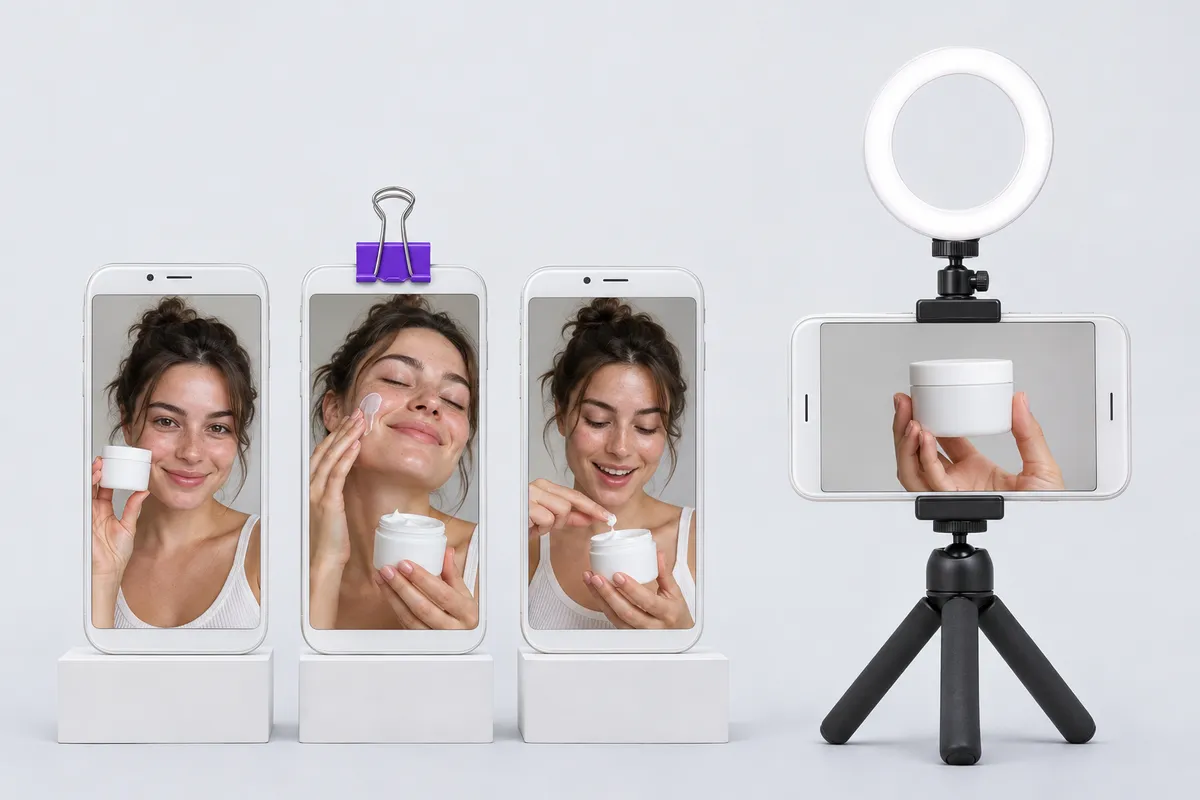
The point is to spend creator money on proof rather than on guessing. One creator video built around an angle you already validated is a better bet than three built around hunches.
A media buyer in r/FacebookAds who had run AI UGC for months asked whether the ads were wearing out faster than other formats. Several replies said yes, and one described the fix that matches this workflow:
"We’re seeing mixed results. AI UGC tends to grab attention early, but fatigue sets in faster than with human-led UGC. The most consistent wins we’ve seen with AI are when AI elements are blended into human-shot content (including b-roll or a simple front-facing camera take). AI can work for quick visual hooks, but real creators are still needed for trust and relatability."
A comment on r/FacebookAds
Fatigue is one more reason to keep the loop running: retire AI variants quickly, and let the creator versions carry the angles that keep working.
The legal line: presenters, not fake customers
The real legal risk with AI UGC isn't the tool. It's what the script makes the avatar claim. The FTC's rule on reviews and testimonials bans any testimonial that misrepresents "that the reviewer or testimonialist exists" or that they "used or otherwise had experience with the product" (16 CFR 465.2). An AI avatar saying "I've used this every morning for a month" breaks both. The same avatar saying "here are three things this serum does" is a presenter, and that's fine.
On top of that, TikTok requires an AI label on ads that are fully generated or heavily changed with AI, Meta adds its own label when it detects AI, and the EU AI Act requires a visible disclosure for realistic AI people. Real creators have their own duty: #ad or a paid partnership label when they were paid or got the product free. Our AI ad disclosure guide covers each platform's rules with sources.
FAQ
What is AI UGC?
AI UGC is a user-generated-content style video ad made with AI, usually an AI avatar or a fully generated person talking about a product to camera. It copies the look of a creator's selfie video, but the person on screen never used the product.
Do AI UGC ads perform as well as real UGC?
Not on average, but it depends on the ad. In Ipsos's 2026 test, human-made ads scored 14% higher on short-term and 17% higher on long-term effectiveness, but AI did well on direct, product-first ads. Use AI to test hooks and angles cheaply, and real creators for testimonials and product proof.
Can people tell if a UGC ad is AI?
Often not. In the Ipsos study, only 25% of people who saw an AI ad were at least somewhat confident it was AI-made. They still rated the human-made ads as more eye-catching and imaginative, and 79% said companies should disclose AI use.
Are AI UGC ads allowed on TikTok and Meta?
Yes. TikTok requires its AI-generated content label on them, and Meta labels AI ads itself when it detects them. In the US, the FTC also bans testimonials that misrepresent whether the person exists or used the product, so the avatar can present but never pose as a customer.
How much cheaper is AI UGC than hiring creators?
Much cheaper per video. A short AI clip in UGC Builder costs $0.65 to $1.80 in credits, while beginner creators charge $50 to $400 a video before paid usage rights. Compare cost per usable ad, since not every AI generation is usable.
- AI UGC
- UGC
- UGC Comparison
- Video Ads
- UGC Creators