UGC Strategy21 min read
UGC Hooks: 122 Ad Hook Examples, Sorted by Type and Niche
122 fill-in-the-blank UGC hooks for TikTok and Meta ads, sorted by hook type and niche, with the first frame to pair them with and how to test them.
Short answer:
- A UGC hook is the first two to three seconds of a creator-style ad: the line the creator says, the text on screen and the first thing the viewer sees. All three have to work, and the picture often matters more than the words.
- Pick the hook type from what the viewer already knows. People who feel the problem stop for a problem callout. People who've never heard of the product stop for a demo or a curiosity hook. People comparing options stop for an objection or an offer.
- TikTok tells advertisers to "prioritize your hook in the first 6 seconds" and to introduce the product in the first 3. Write several hooks for one body and keep the one with the best hook rate and hold rate.
- The fastest way to get an ad rejected is a hook that promises a result: before-and-after shots, "get X in Y days" and anything that sounds like a cure.
Most hook lists online are a few dozen lines with no context. You copy one, it flops, and you don't know why. This guide gives you 122 fill-in-the-blank hooks written for UGC ads, sorted two ways: by hook type, with when each type works and the first frame to pair it with, and by niche, for skincare, supplements, fashion, home, apps, pets and fitness. After the swipe file you'll find how to test hooks against each other and which hooks get ads rejected on TikTok and Meta.
What makes a UGC hook work
TikTok's creative guidance is short on this point: "Prioritize your hook in the first 6 seconds to boost engagement and increase watch time. You can do so by creating suspense, surprise, or other emotions." It adds: "Introduce your content proposition in the first 3 seconds for better recall and awareness" (TikTok creative best practices). So the hook has to do two jobs at once. It stops the scroll, and it tells the viewer what this is about.
A hook has three layers, and most swipe files only give you one of them.
The spoken line is what the creator says. Keep it to one sentence. At the average speaking rate of about 150 words a minute (NCVS), three seconds holds seven or eight words. That's why every hook below is short, and why the long ones work best as on-screen text.
The on-screen text is for everyone watching with the sound off. It doesn't have to repeat the spoken line word for word. Often it works better as a label for the video ("Day 14, no filter") or as the question the viewer is asking. TikTok recommends "captions or text overlays to provide context to your ad" and "displaying 5-10 words per second when using text." Keep it clear of the buttons and captions each app draws on top; our safe zone checker shows where they sit.
The first frame is what decides whether anyone hears the line at all. A creator saying a great sentence to a blank wall loses to an average sentence over a hand pushing the product toward the lens. TikTok also recommends "featuring people such as creators, employees, or customers to capture attention and increase engagement." Movement in the first second, the product in frame, and a face looking at the camera are the three things to check.
Here is the same hook built weak and built well:
| Layer | Weak | Strong |
|---|---|---|
| Spoken line | "Hi guys, so today I want to talk about this cleaning spray." | "This is the worst stain in my apartment." |
| On-screen text | Brand name and logo | "Coffee stain, 2 years old" |
| First frame | Creator sitting on a couch, product out of shot | Close-up of the stain, the spray already in hand |
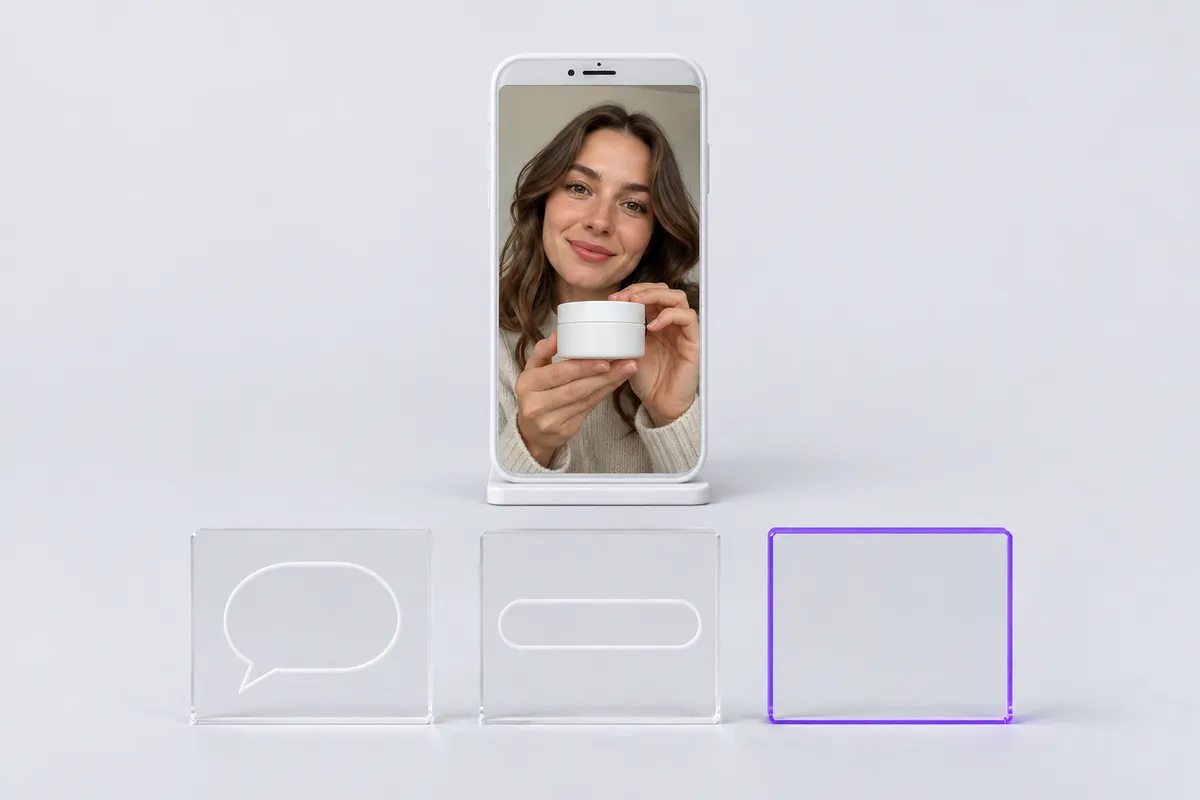
A hook is three layers at once: the line, the text and the first frame. Illustration generated with AI.
Chase Chappell's video below covers the same ground from the media buyer's side. It's built around four hook mistakes: the first one to two seconds, the headline, confusion within the hook, and a missing "interest loop," a question the rest of the video answers.
How to use this swipe file
Each hook has [brackets] to fill in with your product, audience or detail. The more specific the fill, the better it works. "If your dog sheds" is weaker than "If your husky sheds on a black couch."
Start from the viewer, not the list. Someone who already feels the problem will stop for a problem or persona callout. Someone who has never heard of your product needs to see it do something, so use a demo or curiosity hook. Someone who has been comparing options for a week responds to objections, social proof and offers. If you're not sure, write one hook from three different types and let the results decide.
The hook is only the opening. For the beats that come after it (problem, product in use, proof and call to action), how many words fit in 15 or 30 seconds, and a script timer, see our UGC script guide.
UGC hooks by type
Problem callout
Use it when your product fixes a specific, everyday annoyance that the viewer already notices. It does the targeting for you: people without the problem scroll past, which is fine. Open on the problem happening, not on the creator describing it.
| # | Hook |
|---|---|
| 1 | "If your [thing] keeps [annoying problem], watch this." |
| 2 | "[Problem] at [specific time] again? Same. Here's what I do now." |
| 3 | "Nobody warned me that [problem] starts after [life event]." |
| 4 | "This is what [problem] looks like at [time] in the morning." |
| 5 | "I was losing [time] a day to [chore] until I tried this." |
| 6 | "Stop [common workaround]. It's why your [thing] keeps [problem]." |
| 7 | "The [problem] nobody mentions when you [start activity]." |
| 8 | "If [problem] is the reason you [avoid something], keep watching." |
Persona callout
Use it when the product is broad but the buyer is specific. Naming the person ("night-shift nurses", "first-time dog owners") makes the right people feel seen and gives the ad platform a clear signal about who the video is for. The first frame should show where that person lives or works: a locker room, a home office, a car seat.
| # | Hook |
|---|---|
| 9 | "If you're a [persona] who [habit], this one's for you." |
| 10 | "[Persona]s, I need you to see this." |
| 11 | "POV: you're a [persona] and it's [stressful moment]." |
| 12 | "Every [persona] I know keeps one of these in their [bag/desk/car]." |
| 13 | "Things I wish someone told me as a new [persona]." |
| 14 | "For the [persona] who has tried every [category] out there." |
| 15 | "If you [specific habit], you're going to want this." |
| 16 | "Calling all [persona]s with [constraint: no time, a small kitchen, two kids]." |
Result and before-after
Use it when the result is visible, real and typical, and the person on camera actually got it. Show the "after" first, then rewind. This is also the type that gets rejected most often, so read the policy section before you use it for skincare, weight or health products. For home, cleaning, organizing and apps, it's usually the strongest type you have.
| # | Hook |
|---|---|
| 17 | "This is my [thing] after [time] of using [product]." |
| 18 | "Day 1 versus day [number]. Same room, same light, no filter." |
| 19 | "The only thing I changed was [product]. Here's what happened." |
| 20 | "My [thing] used to look like this. Now it looks like this." |
| 21 | "[Number] weeks with [product], unedited." |
| 22 | "This took me [time]. Here's exactly how." |
| 23 | "What [amount of money] of [product] actually gets you." |
| 24 | "I didn't expect [small detail] to change, but it did." |
Curiosity
Use it for products that look unusual or work in an unexpected way. The hook opens a question and the next few seconds have to answer it. If the payoff comes at second 20, people leave at second 4 and your hold rate drops. Start on the strange object or the half-finished action.
| # | Hook |
|---|---|
| 25 | "I can't believe this [object] is actually a [category]." |
| 26 | "This is the weirdest [category] I own, and I use it every day." |
| 27 | "Watch what happens when I [action]." |
| 28 | "There's a reason [professionals] all [do something] this way." |
| 29 | "I finally found out why my [thing] kept [problem]." |
| 30 | "Okay, why is there a [object] in my [room]?" |
| 31 | "The [category] trick [professionals] use and never post about." |
| 32 | "You're probably [everyday action] wrong. Here's the [number]-second fix." |
Contrarian and myth
Use it in crowded categories where everyone repeats the same advice and your product does something different. It works on experienced buyers who have heard every pitch. The claim has to be true and something you can back up in the next sentence. Showing the creator doing the "wrong" thing on purpose makes a good first frame.
| # | Hook |
|---|---|
| 33 | "Unpopular opinion: you don't need [popular product or step]." |
| 34 | "Stop buying [category] for [the wrong reason]." |
| 35 | "Everyone says [common advice]. I tried the opposite." |
| 36 | "[Common belief] is a myth, and here's how I know." |
| 37 | "As a [real profession], I'd never [common practice]." |
| 38 | "The most overrated step in your [routine]." |
| 39 | "Expensive [category] isn't the problem. [Real cause] is." |
| 40 | "I quit [popular thing] for [time] and nothing bad happened." |
Hook 37 only works if the creator really has that job. A creator or an AI avatar pretending to be a nurse or a dermatologist is a misleading endorsement.
Social proof
Use it when you have real proof to show: review counts, comments, a restock, a friend who stole the product. It works best on viewers who have seen your brand before and need a reason to trust it. Put the proof on screen as the first frame (a scrolling review page, the comment, the empty shelf) instead of just saying it.
| # | Hook |
|---|---|
| 41 | "This has [number] reviews and I finally get why." |
| 42 | "I read the [1-star] reviews of [product] so you don't have to." |
| 43 | "My [partner/mom/roommate] keeps stealing my [product]." |
| 44 | "This comment is the reason I tried [product]." |
| 45 | "Why is everyone in [community] talking about [product]?" |
| 46 | "TikTok made me buy it, and I'm actually keeping it." |
| 47 | "[Number] of you asked what I use for [result]. Here it is." |
| 48 | "This sold out [number] times. I finally got one." |
Every number in these has to be true on the day the ad runs.
Objection
Use it when you know why people don't buy: the price, the effort, "I've tried this before," or "another subscription." Saying the doubt out loud before the viewer thinks it builds trust fast, and it's the type that works best on people who have been comparing options. Open on a skeptical face, a price tag or the cheaper alternative.
| # | Hook |
|---|---|
| 49 | "[Price] for a [category]? Let me explain." |
| 50 | "I was sure this was a gimmick. Here's what changed my mind." |
| 51 | "'Isn't this just a [cheaper alternative]?' No, and here's the difference." |
| 52 | "You don't need [skill or time] for this. I tried it with [constraint]." |
| 53 | "Is [product] worth it after [time]? Honest answer." |
| 54 | "The one thing I don't like about [product]." |
| 55 | "If you've tried [category] before and quit, this one's different because [reason]." |
| 56 | "Yes, it's another subscription. Here's why I kept it." |
Demo and visual-first
Use it when the product does something visible in a few seconds: it pours, sticks, folds, cleans, lights up or survives a drop. Here the picture is the hook and the line just points at it. These are also the easiest hooks to make work with the sound off.
| # | Hook |
|---|---|
| 57 | "Watch how fast this [does task]." |
| 58 | "One [swipe/pour/press] and look at this." |
| 59 | "This is [number] seconds of [product] doing [task]." |
| 60 | "I'm going to [stress test] this and see if it survives." |
| 61 | "[Task] with my old [tool], then with [product]." |
| 62 | "No cuts: [task] from start to finish." |
| 63 | "Let me show you what's inside." |
| 64 | "Look at the [texture/detail] on this." |
Price and offer
Use it when you have a real offer and the viewer already knows the product: retargeting, launches, sales. It's a weak opener for cold audiences who don't yet care what it costs. Show the product with the price or offer as on-screen text, and make sure it matches the landing page exactly.
| # | Hook |
|---|---|
| 65 | "[Product] is [discount] off until [date]. Here's what I'd get." |
| 66 | "Everything in this [bundle] costs less than [everyday comparison]." |
| 67 | "This works out to [price] a [day/use]." |
| 68 | "If [product] has been sitting in your cart, this is your sign." |
| 69 | "Free [gift] with [product] this week. Here's what's in it." |
| 70 | "The [price] [category] that replaced my [more expensive thing]." |
| 71 | "Don't pay full price for [product]. Here's the [bundle/code]." |
| 72 | "What [budget] gets you at [brand] right now." |
Storytime
Use it for products people think about before buying, or where the reason to buy is a moment in someone's life. Storytime hooks hold attention longer than they stop it, so they suit 30 to 60 second ads more than 10-second ones. Open mid-scene, in the car or the kitchen, as if the viewer walked in on a conversation.
| # | Hook |
|---|---|
| 73 | "So this happened at [place] yesterday." |
| 74 | "The day I realized I needed a [category] was [moment]." |
| 75 | "Storytime: how a [small product] saved my [event]." |
| 76 | "My [relative] called me out for [habit], and she was right." |
| 77 | "I was this close to canceling [product]. Then [event] happened." |
| 78 | "[Time] ago I was [situation]. This is what changed." |
| 79 | "Nobody believed me about [claim], so I filmed it." |
| 80 | "I owe my [friend/coworker] an apology about [product]." |
UGC hooks by niche
The same types work everywhere, but each niche has its own visuals and its own rules. These hooks are written to stay inside the platform policies covered further down.
Skincare and beauty
Lead with texture, shade and routine, not with flaws. Meta doesn't allow cosmetic ads that attack the viewer's appearance, so "Is your skin this dull?" is out.
| # | Hook |
|---|---|
| 81 | "My [step] routine when I only have [number] minutes." |
| 82 | "Swatching all [number] shades on [skin tone] in daylight." |
| 83 | "What this [texture] feels like, in [number] seconds." |
| 84 | "The [product] I reach for when my makeup won't sit right." |
| 85 | "Everything I do at night that takes under [time]." |
| 86 | "The step I added after my [esthetician] told me [advice]." |
Supplements and health
Talk about the routine, the taste and the label, not outcomes. No cures, no "in 7 days", no symptoms disappearing.
| # | Hook |
|---|---|
| 87 | "What's in my [time of day] [supplement], and why." |
| 88 | "I read the whole label so you don't have to." |
| 89 | "How I actually remember to take [supplement] every day." |
| 90 | "[Supplement] taste test, honest reaction." |
| 91 | "My [morning/evening] routine, with [supplement] in it." |
| 92 | "The questions I asked before trying [supplement]." |
Fashion
Fit and versatility are the questions every shopper has. Show the item on a real body, moving.
| # | Hook |
|---|---|
| 93 | "One [item], [number] ways to wear it." |
| 94 | "I'm [height], here's how [item] actually fits." |
| 95 | "Trying on sizes [X] and [Y] so you can pick." |
| 96 | "The [item] I wear on repeat, after [number] washes." |
| 97 | "An outfit for [event] under [budget]." |
| 98 | "Everything I packed for [trip] in one carry-on." |
Home and kitchen
Messes and time savings are visual, which makes this the natural niche for demo and result hooks.
| # | Hook |
|---|---|
| 99 | "My [appliance] does [task] while I [other task]." |
| 100 | "Cleaning the [spot] I've avoided for a year." |
| 101 | "Dinner for [number] in [time], one pan." |
| 102 | "The small [room] fix I wish I'd done sooner." |
| 103 | "This [gadget] is why my [drawer/counter] looks like this now." |
| 104 | "Testing [product] on the worst [stain] in my house." |
Apps and SaaS
The first frame is a phone or laptop screen with a face in the corner. Show one task getting done, not a tour of features.
| # | Hook |
|---|---|
| 105 | "I [task] in [time] with this app. Watch my screen." |
| 106 | "If you still do [task] in a spreadsheet, look at this." |
| 107 | "[Number] apps I deleted after I found this one." |
| 108 | "The setting in [app] nobody turns on." |
| 109 | "How I plan my [week/budget] in [time] every [day]." |
| 110 | "Watch me [task] without leaving my phone." |
Pets
The pet is the first frame. Real reactions beat any line the owner can say.
| # | Hook |
|---|---|
| 111 | "My [breed] has strong opinions about this [product]." |
| 112 | "If your [pet] does [behavior], try this." |
| 113 | "[Pet name] trying [treat/toy] for the first time." |
| 114 | "What my [pet] does while I'm at work." |
| 115 | "The question I asked our vet before switching [pet]'s food." |
| 116 | "[Pet] owners with a [floor/couch type], this one's for you." |
Fitness
Show the workout or the gear in use. Results claims about weight or body shape are restricted, so stick to the routine.
| # | Hook |
|---|---|
| 117 | "My [time]-minute [workout] when I can't get to the gym." |
| 118 | "The [gear] I bring to every [session]." |
| 119 | "Form check: [exercise] with and without [product]." |
| 120 | "What I eat before a [time] [run/lift]." |
| 121 | "A beginner [workout] you can do in [small space]." |
| 122 | "What I stopped bringing to the gym after I got [product]." |
How to test UGC hooks
Keep the body of the ad and swap only the first two or three seconds. If one opening gets more people to stop and they stay just as long, you've found a better hook without reshooting the ad. TikTok suggests "between 3-5 different creatives per ad group" and adds that "it is always better to use creatives with big differences, especially when testing." So don't test five wordings of the same problem callout. Test a problem callout against a demo against an objection, ideally with different first frames.
Someone who screens UGC samples for brands described the same filter in r/UGCcreators. Greetings, intro cards and logo animations get skipped, and so do generic question hooks like "Want glowy skin?", which "reads like an ad." Their reason the first frame matters so much:
"We screen sound off first. Your first frame is already doing the hook's job."
They also cut hooks that don't deliver: "We check the timestamp where the thing you promised actually shows up" (r/UGCcreators). Your viewers run the same check, and hold rate is where you see it.
Judge each hook on hook rate, the share of impressions that turned into a 3-second view on Meta or a 2-second view on TikTok. Our hook rate guide covers the formula, benchmarks and how to add it in Ads Manager, and the free hook rate calculator tells you whether the gap between two hooks is bigger than chance. Read it next to hold rate. A shocking hook that doubles your hook rate and halves your hold rate attracted people who were never going to buy. If hook rate and hold rate are both low, the angle is wrong, and a new wording won't fix it.
Write down every result in a hook log: the hook, its type, the first frame, hook rate, hold rate and cost per purchase. After a few rounds you'll see which types work for your product, which is worth more than any list.
AI UGC makes hook tests cheaper because you don't need to rebook a creator for each opening. In UGC Builder's Premium UGC, you paste the line and an on-screen actor speaks it in an 8-second clip for 200 credits, so you can generate several spoken openings and put them in front of the same body. Plans start at $9 a month for 100 credits, and Ultra is $39 for 1,200. Keep AI hooks to presenter lines like hooks 41, 51 or 57. An avatar hasn't used your product, so first-person results like hook 17 don't belong in its mouth.
Hooks that get ads rejected
Hooks are where most policy problems start, because the urge to promise a result is strongest in the first line.
TikTok's ad policy says ads "must not promise or exaggerate results concerning a product's effect." Its examples of what's not allowed include a lotion ad saying "Get slim legs right away," "claims of cures for incurable diseases" and "showing wrinkles disappearing by using a cream through before-and-after comparisons." It also rules out "deceptive language to lure viewers into clicking," which is the line curiosity hooks can cross, and ad content that doesn't match the landing page on "the promotion, price, discounts," which is the one offer hooks cross (TikTok misleading and false content policy).
Meta's Health and Wellness policy is just as strict for weight loss and cosmetic ads. They can't contain "statements of inferiority about physical appearance," which it defines as "terms, descriptions, or questions that are negative and attack an individual's appearance, specific body parts, or hygiene." In a health, weight loss or weight gain context, ads can't use "sensational language with exaggerated or extreme claims, or promises of specific outcomes within a set timeframe without disclaimers or qualifiers" (Meta Advertising Standards). That rules out a lot of classic problem hooks, like "Is your belly doing this?", and most "in 7 days" result hooks.
Three rules keep hooks safe on both platforms. Only use a result hook when the person on camera got that result and it's typical. Never write "this cured my..." or anything that sounds like treating a condition. And never put a first-person story in the mouth of someone who didn't live it, whether that's a paid creator reading a script or an AI avatar. The FTC treats a fake testimonial as a fake testimonial, whatever made the video. Our AI ad disclosure guide covers that rule and the AI labels TikTok and Meta add.
FAQ
What is a UGC hook?
A UGC hook is the opening of a user-generated-content style ad, usually the first two to three seconds. It has three parts: the line the creator says, the text on screen and the first visual. Its job is to stop the scroll and tell the viewer what the video is about.
What are the best hooks for UGC ads?
There's no single best hook. Problem callouts and demos are the safest starting points for cold audiences, while objection, social proof and offer hooks work better on people who already know the product. Test hooks from different types against each other and let hook rate and cost per purchase decide.
How long should a UGC hook be?
Aim for one sentence the creator can say in about three seconds, which is seven or eight words at a normal pace. Longer hooks can work as on-screen text, as long as the first frame already shows what the video is about.
How many hooks should I test per ad?
Three to five is a good start. TikTok suggests 3 to 5 different creatives per ad group, and swapping only the opening of one body is the cheapest way to get them. Make the hooks different in type and first frame, not just in wording.
Do TikTok ad hooks work on Meta?
Usually, since both platforms show vertical video in a feed and both reward a fast, clear opening. Check the on-screen text against each app's interface, and run each hook on both platforms rather than assuming a winner on one will win on the other.
- UGC
- UGC Scripts
- Video Ads
- TikTok Ads
- Meta Ads