UGC Strategy10 min read
How to Generate UGC Ads with UGC Builder: 2026 Step-by-Step
Make UGC photo and video ads from one product photo with UGC Builder: which tool to use, step-by-step settings, credit costs and a simple testing plan.
Key takeaways:
- You need one clear product photo. Everything else (the person, the setting, the script) is picked in the tool.
- Use UGC Photo for static ads, UGC Video or UGC Studio for short video ads, and Premium UGC when you want an 8-second clip with a spoken line and native audio.
- An image costs 4 credits and a 5-second video 20 credits. Plans start at $9/month for 100 credits (about 25 images or 5 short videos). A first batch of 10 images and 10 short videos fits in the PRO plan ($19/month, 400 credits).
- Download every result right away. Generated files aren't stored.
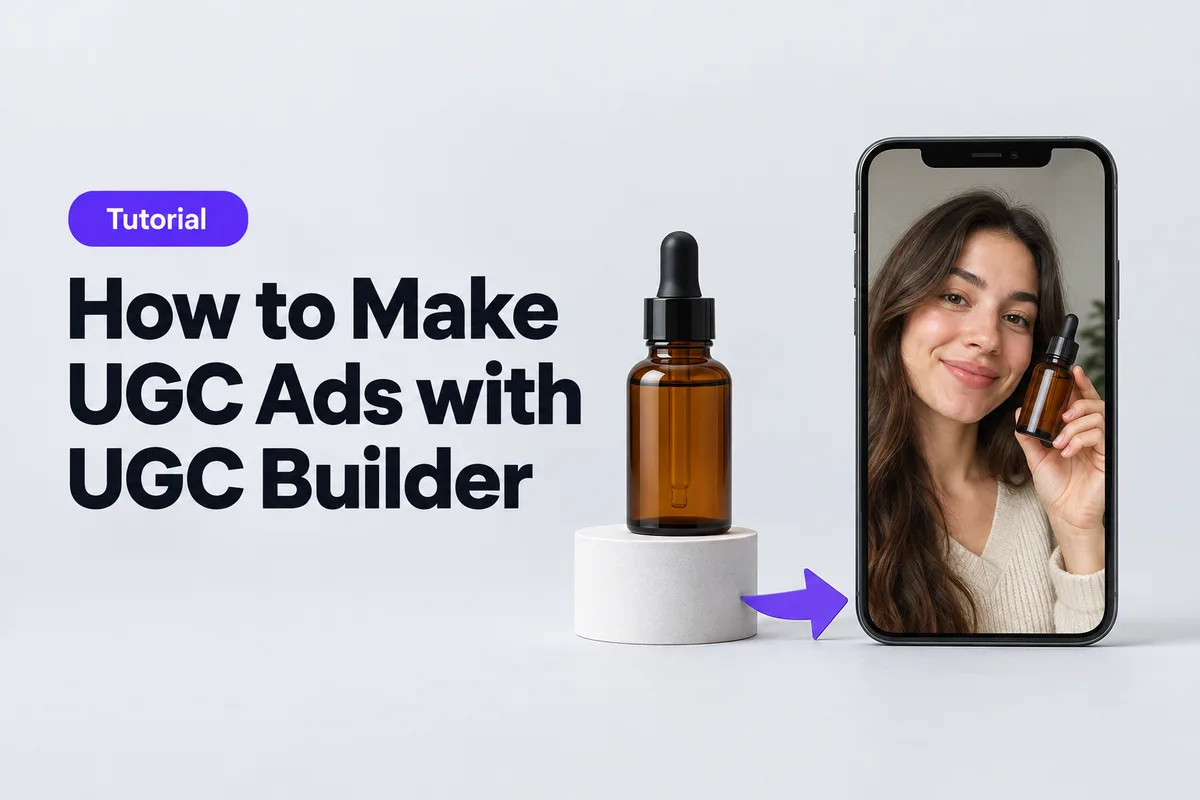
This guide walks through a first batch of UGC-style ads in UGC Builder, from picking a tool to a one-week test. The examples use one product throughout: a small bottle of vitamin C face serum.
Pick the right tool
| Tool | What you get | Good for | Cost |
|---|---|---|---|
| UGC Photo | A photo of a person using or holding your product | Feed ads, product pages, emails | 4 credits per image |
| UGC Video | A short UGC-style clip: review, unboxing, tutorial | TikTok, Reels, Shorts | 20 credits per 5-second video |
| UGC Studio | An AI virtual creator reading your script | Talking-head ads and testimonials | 20 credits per video |
| Premium UGC | An 8-second, higher-quality clip with native audio and the accent you choose | Hero ads, launches | 200 credits per ~8-second clip |
| Landing page | A full product landing page from the same photo | Where the ad sends traffic | 20 credits |
If you'd rather not fill in forms, the AI Agent does the same work from a chat. You describe what you want, attach the photo, and it runs the right tool.
Before you start: 10 minutes of planning
Settle a few things before you spend a credit: the goal (a launch, a best-seller push, retargeting) and the buyer. "Women aged 25 to 40 with dull skin who don't want a ten-step routine" gives you far more to work with than "skincare fans".
Next, decide where the ad will run, because that fixes the format: vertical for TikTok, Reels and Shorts, square or 4:5 for feeds. Plan at least 5 to 10 versions so you have something to compare.
Then prepare the product photo. A sharp image on a transparent or plain background works best, because the tool places the product into a new scene. A phone shot of the serum on white paper by a window is enough.
Step 1: Create UGC photo ads
Open UGC Photo from the sidebar and upload your product image, or pick one from the template library. You then choose a style (casual, lifestyle, testimonial and so on), the person in the photo (age range, gender, look) and the setting (home, outdoors, workplace, gym). Click Generate and download the image straight away.
Match the person to your buyer, not your team: for the serum, a woman in her early thirties at a bathroom mirror, not a studio model. Put the product where people use it; a bathroom shelf looks more real than marble. The casual style with natural light is closest to a real customer photo. Change one thing per variation, the person or the setting, so you know why a version won.
Step 2: Create UGC video ads
UGC Video works the same way. Upload the product image, pick a template (review, unboxing or tutorial), choose the actor's age range, gender and style, and add a short script or talking points. It's optional, but a clip built around a line like "Two drops before moisturizer, that's my whole routine" is easier to judge. Choose the length, generate, and download right away. Keep it vertical or square for TikTok and Instagram, and start with 5-second clips: at 20 credits each, a miss is cheap to redo.
Want a creator reading your script?
Use UGC Studio. Select the product photo, paste a script of up to 500 characters, choose the creator's nationality and gender, and click Generate Ad Video. It usually takes a few minutes.
Step 3: Make a Premium UGC clip
Save Premium UGC for the ad you plan to spend the most on. Go to Create → Premium UGC, upload a clear product image and paste the exact line the person should say. It has to fit in about 8 seconds, so one or two sentences: "I used to buy three serums. Now I buy this one." Pick the accent that matches your market, and optionally set gender, video style and a short character description.
Each clip costs 200 credits. You can extend it by roughly 7 seconds per step, at another 200 credits each, so a ~15-second video is 400 credits. Find a winning angle with the cheaper tools first.
Step 4: Write scripts that sound like a customer
A simple structure for 15 to 30 seconds:
[Hook, 2-3 s]      "I was so tired of [problem]..."
[Product, 2 s]     "...then I tried [Product]."
[Benefit, 5-10 s]  "Now [specific result]. The [feature] is what did it for me."
[Proof, 2-3 s]     A real review quote or a real number from your store
[CTA, 2 s]         "Link's below if you want to try it."
Only use proof you can back up. If you don't have a review count yet, skip that line.
Write the way people talk. "Our formula is enriched with antioxidants" is brochure copy. "I put it on before my moisturizer and I'm done in ten seconds" is what a person says. Read the script out loud: if it sounds like the back of the box, cut it.
Make it look less like AI
AI ads that flop usually look too clean: perfect light, a glossy set, a presenter who sounds like a newsreader. Pick home or outdoor settings, the casual style, and scripts with contractions. Real UGC is filmed on a phone at arm's length, so aim for that look.
Be realistic about hands. AI video still struggles when someone opens a box, squeezes a tube or applies a product up close, and that's where glitches show. Choose shots where the product is simply held up to the camera and let the script do the demonstrating. If the ad needs a texture shot or a before-and-after, film that part on your phone and cut it into the AI clip.
Step 5: Build variations and test them
Change one variable per batch, starting with the hook, since it decides whether anyone watches the rest. Run the same serum script with three openers: "I wish I'd found this sooner", "I didn't expect this to work" and "My sister made me try this". Once a hook wins, keep it and test the person, then the benefit, then the format.
A simple first week looks like this:
- Days 1 and 2: generate 10 to 20 variations.
- Days 3 to 5: run them with small, equal budgets.
- Days 6 and 7: compare cost per purchase (or cost per click if you don't have enough sales yet), pause the weakest, and make new versions of the best two or three.
Test tools the same way you test ads. An advertiser spending about $7K a day, who tried Artlist, HeyGen, AdCreative, Synthesia and Creatify for image and video creatives, said to trust a free trial over YouTube reviews because most review videos are promotional. In the replies, they said they mostly ran real UGC ads, sourced from outreach and from loyal customers reviewing products for credits.
"Trust a free trial instead of YouTube reviews"
The original poster on r/FacebookAds
For more ad angles, see these UGC campaign ideas.
For a general walkthrough of how AI UGC ads are made, watch this full tutorial, which isn't about UGC Builder specifically.
AI UGC or real creators?
AI UGC is cheap to redo, so it's good at finding the message. A real creator costs more but brings an honest reaction, real hands on the product and an audience that trusts them. Anything built on lived experience, like a skin result after six weeks or a founder story, should come from a real person.
Disclosure and platform rules
A real creator who is paid or gets free product has to say so, usually with #ad or the platform's paid partnership label. With AI UGC the same idea applies: don't present a generated person as a real customer. In the US, the FTC's rule on fake reviews and testimonials bans testimonials that pretend to come from someone who doesn't exist, and it names AI-generated reviews as an example.
So write AI scripts as demonstrations ("here's how I use it"), not invented results ("I lost 5 kg in a month"). TikTok and Meta also have their own rules for labeling AI-generated content, and they change, so check each platform's ad policy before you launch.
What a first batch costs
A realistic first batch is 10 UGC photos at 4 credits each (40 credits), 10 five-second UGC videos at 20 credits each (200 credits) and one landing page (20 credits). That's 260 credits, which fits in the PRO plan (400 credits for $19/month). The Starter plan ($9/month, 100 credits) covers a smaller first test, for example 10 photos and 3 videos. Ultra gives 1,200 credits for $39/month. Plans are monthly subscriptions, not pay-as-you-go, and credits expire 30 days after they're added. See pricing for the full breakdown.
The same credits work inside ChatGPT and Claude through the MCP connector, on every plan. A standard 15-second UGC video made there, or with the AI Agent, uses 40 credits.
Common mistakes
The usual mistake in a first test is making too few versions. Two or three ads rarely tell you anything, so start with ten. Also check the aspect ratio before you generate, save files as soon as they're ready, and use what the first batch taught you to make the second.
FAQ
How much does it cost to make a UGC ad with UGC Builder?
An image uses 4 credits, roughly $0.36 on the $9 Starter plan. A 5-second video uses 20 credits, roughly $1.80 on Starter. Both cost less per item on bigger plans. A Premium UGC clip uses 200 credits per ~8-second step.
Is UGC Builder pay-as-you-go?
No. Plans are monthly subscriptions starting at $9 for 100 credits, and you can cancel anytime. There are no one-off credit packs, and unused credits expire 30 days after they're added.
Do AI UGC ads need to be disclosed?
Follow each platform's current rules on AI-generated content. More important, don't pass off an AI person as a real customer or give them results nobody had. In the US the FTC bans fake testimonials, including AI-generated ones.
Can AI UGC replace real creators?
For testing hooks, angles and formats, mostly yes. For ads that depend on a real experience or a creator's audience, you still want a person. Many brands test ten AI versions, then pay a creator to film the winner.
Can I make UGC ads from ChatGPT or Claude?
Yes. UGC Builder connects to ChatGPT and Claude through MCP on every plan, using the same credit balance as the website.
- UGC Builder
- UGC Ads
- AI Tools
- Marketing
- Content Creation
- E-commerce